
A plot your father left that you and your siblings cannot agree on, a contractor months past the delivery date, a tenant who will not leave or a sale at the land registry made without your knowledge: as a real estate lawyer in Adana, we protect your rights in these disputes from the very first step.
Property disputes are often intertwined with family and neighbor relationships. If a case is filed in the wrong court or mandatory mediation is skipped, it can be dismissed without the merits ever being examined.
At the Initial Consultation, we go through your title record (tapu kaydı) and documents with you, calculate the deadlines already running and choose the right route from the start.
Choose the option that matches your situation to go to the relevant section.
There is a problem with my title record, or a case has been filed over my title
I have a problem with the rent or an eviction
I want to divide a co-owned or inherited property
My property is being expropriated, or a public authority has taken it over
I am about to sign a contract with a contractor, or the construction is delayed
How Can a Real Estate Lawyer in Adana Help You?
A real estate lawyer in Adana handles the review before filing, mediation where it is required and the lawsuit in a property dispute, and checks the title record and the contract before a purchase or sale so that no rights are lost. Our main areas of work are:
- actions for cancellation of title and registration;
- construction-for-flats agreements, delays and transfer of title;
- rent determination, eviction and rent claims;
- partition of co-owned or inherited property;
- expropriation compensation and de facto expropriation;
- actions to prevent interference, compensation for unauthorized use, preemption, right of way and boundary disputes;
- common charges, assembly decisions and the management plan in condominiums;
- review of the title record, zoning status and occupancy permit before buying real estate.
In separate cases, we act for either side: the landlord or the tenant, the landowner or the contractor, the owner or a co-owner. Attorney Saim İncekaş is registered with the Adana Bar Association (registration no. 4293).
We handle the annulment of zoning plans and expropriations in our administrative law practice, sham transfers by the deceased and the details of dividing an inheritance in our inheritance law practice, and mortgage foreclosure in our enforcement law practice; the acquisition of property by foreigners is explained on our separate page for foreign buyers.
Which Court Hears a Real Estate Case in Adana?
Under Turkish law, the general court for real estate cases is the civil court of first instance (asliye hukuk mahkemesi). Lease, partition (ortaklığın giderilmesi, izale-i şuyu) and condominium cases, and cases seeking only to protect possession, go to the civil court of peace (sulh hukuk mahkemesi). If you bought a home as a consumer, the consumer court (tüketici mahkemesi) hears the case. Commercial cases go to the commercial court of first instance (asliye ticaret mahkemesi), and challenges to a cadastral record to the cadastral court (kadastro mahkemesi). The annulment of zoning and expropriation decisions is a matter for the administrative court (idare mahkemesi).
Subject-matter jurisdiction (görev) determines the type of court, and venue (yetki) the place. The court type depends on the parties’ relationship and the relief sought, not on the name of the case. The rules on subject-matter jurisdiction are a matter of public order and cannot be changed by agreement (Code of Civil Procedure No. 6100, HMK Articles 1, 2 and 4; Condominium Law No. 634, KMK Additional Article 1). The Adana Courthouse (Adana Adliyesi) has civil courts of first instance and of peace, and consumer, commercial and cadastral courts.
A case filed with the wrong type of court, or in breach of exclusive venue, ends with a ruling that the court lacks jurisdiction or venue. Between civil courts, if neither party requests transfer of the case within the two-week period in HMK Article 20, the case is deemed not to have been filed. An expert real estate lawyer identifies the right court before filing, from the title record, the contract and the parties’ status.
Competent Turkish courts for the main real estate disputes:
| Dispute | Competent court | What to watch |
|---|---|---|
| Cancellation of title and registration | Civil court of first instance | Cadastral court if the claim rests on a ground predating the cadastral record and the record is not yet final; consumer court if it arises from a consumer transaction |
| Ownership-based action to prevent interference and compensation for unauthorized use (ecrimisil) | Civil court of first instance | Civil court of peace if only protection of possession is sought |
| Preemption (önalım, şufa) | Civil court of first instance | The deadlines for filing are short; deadlines and price are covered in the preemption section |
| Right of way (geçit hakkı) | Civil court of first instance | Mediation is mandatory before filing |
| Rent determination, rent claims and eviction by lawsuit | Civil court of peace | Mediation is mandatory before filing; in eviction through enforcement proceedings, removal of the tenant’s objection and eviction may be requested from the enforcement court (icra mahkemesi) |
| Partition of co-owned property (izale-i şuyu) | Civil court of peace | Mediation is mandatory before filing |
| Condominium: common charges, assembly decisions, management plan | Civil court of peace | Mediation is mandatory before filing |
| Construction-for-flats agreement | Civil court of first instance; commercial court of first instance if it concerns both parties’ commercial enterprises | In a commercial case whose subject is a sum of money, mediation is mandatory before filing |
| Consumer purchase of a home from a developer | Consumer court | Below the monetary threshold, the consumer arbitration committee must be approached first |
| Determination of expropriation compensation and registration | Civil court of first instance; the expropriating authority files the case | Annulment of the expropriation is a separate case before the administrative courts, with a short deadline |
| De facto expropriation by physical taking | Civil court of first instance | Depending on when the taking occurred, the settlement procedure with the authority may be required first; for a restriction arising from a zoning plan, the route is examined separately |
| Challenge to a cadastral record | Cadastral court | Filed within the thirty-day public posting period; once the record is final, a title case based on a right predating the cadastre goes to the civil court of first instance |
Which Title Deed Cases Does the Cadastral Court Hear?
The cadastral court hears only disputes arising from cadastral work, mainly actions against the cadastral record (kadastro tutanağı) filed within the thirty-day public posting period (askı ilanı) and cases transferred from other courts once the record is drawn up (Cadastre Law No. 3402, Articles 11, 26 and 27). Claims based on rights arising after the record was drawn up, partition, and claims such as acquiring the land on the basis of structures or improvements on it (muhdesat) or having them removed fall outside its jurisdiction (Article 25).
Once the record is final, an action for cancellation of title and registration based on a pre-cadastre right is filed in the civil court of first instance; having a cadastral court at the Adana Courthouse does not mean every title case goes there.
If no case is filed during the posting period, the cadastral record becomes final; ten years after that, no case can be brought on legal grounds predating the cadastre, and the period runs from finality, not from a later sale or transfer by inheritance (Cadastre Law No. 3402, Article 12).
This limit is decisive for someone who learns years later that a field left by their father was recorded in another person’s name in the cadastre; at the first review, the cadastral record and the title record are read together. Boundary and measurement errors are covered in the section on land, co-ownership and neighbor disputes.
Where Is the Case Filed If the Property Is in an Adana District?
A case concerning ownership of a property, other rights in rem over it or its possession, or one that may change who holds such a right, is filed where the property is located. This is exclusive venue: the parties cannot choose another place, and the court checks venue of its own motion (HMK Articles 12 and 19). For a property in one of Adana’s districts (ilçe), the right courthouse depends on the type of competent court and the area that court serves (yargı çevresi); not every district has every type of court.
This exclusive venue does not apply to claims for payment, such as rent or another sum owed under a contract; these cases can be filed where the defendant is domiciled or where the contract is to be performed (HMK Articles 6 and 10). If the defendant raises no venue objection in the statement of defense, the court where the case was filed becomes competent.
In exclusive-venue cases, the district, neighborhood, block and parcel in the title record help identify the competent courthouse; your lawyer files the case on that basis and avoids the time a ruling of lack of venue would cost.

If You Bought Your Home From a Developer, Is a Dispute Over the Purchase Heard by the Consumer Court?
Yes, if you bought the home for a non-commercial, non-professional purpose such as living in it, from a developer or another seller acting commercially: the consumer court hears cases arising from that sale (Law No. 6502 on Consumer Protection, Article 73). This includes an action for cancellation of title and registration arising from a home sale (Turkish Court of Cassation, 7th Civil Chamber, decision of 19 September 2024, E.2023/4542, K.2024/3978).
However, for disputes below the monetary threshold, which is updated every year, you must first apply to the consumer arbitration committee (tüketici hakem heyeti) under Article 68; a small claim for unfinished work may fall within this limit.
The law’s definition of goods covers homes and holiday properties (Article 3). For the purchase of shop premises, the competent court is determined under the general rules: the Court of Cassation (Yargıtay) upheld a decision finding that such a purchase was not a consumer transaction (Court of Cassation, 7th Civil Chamber, decision of 12 June 2024, E.2023/576, K.2024/3455).
Where no consumer court has been set up and the area is not served by another consumer court, the civil court of first instance hears these cases acting as a consumer court. Sales and payment documents show the nature of the relationship; the mediation rules for consumers are in the mediation section.
Is Mediation Mandatory Before Filing a Real Estate Lawsuit?
Not for every real estate lawsuit. Mediation before filing is mandatory in four groups of disputes: lease disputes, except eviction through enforcement proceedings without a court judgment; disputes over the division or partition of property; disputes under Condominium Law No. 634; and neighbor law disputes (Law No. 6325 on Mediation in Civil Disputes, HUAK Article 18/B). The Court of Cassation also treats a right-of-way action for land without adequate road access as subject to this requirement (Court of Cassation, 7th Civil Chamber, decision of 18 June 2025, E.2025/2206, K.2025/3077). Actions for cancellation of title and registration, preemption and expropriation compensation are not on this list; commercial and consumer disputes have separate rules, set out below.
The application goes to the mediation office (arabuluculuk bürosu) where the court with venue over the dispute sits (HUAK Article 18/A(4)). From the application until the final mediation report (son tutanak) is drawn up, the limitation period (zamanaşımı) is suspended and preclusive periods (hak düşürücü süre) do not run (HUAK Article 18/A(15)). An application made within the filing period also stops the one-month period for certain eviction actions; the remaining time runs after the final report.
Your lawyer prepares the application and represents you at the mediation meeting; this requires express authority in the power of attorney.
Is Mediation Mandatory in a Construction-for-Flats Dispute?
As a rule, no: a construction-for-flats agreement (kat karşılığı inşaat sözleşmesi) does not by itself make mediation mandatory; the parties’ status and the relief sought decide. If the dispute is a commercial case, mediation is mandatory before filing one of these actions whose subject is a sum of money: a claim for a debt or damages, annulment of an objection to enforcement, a declaration that no debt is owed, or recovery of money paid but not owed (Turkish Commercial Code No. 6102, TTK Article 5/A).
Non-monetary claims, such as deleting an annotation (şerh) or handing over the property, fall outside this rule. In one case, the Court of Cassation did not require mediation even for the damages claim brought together with such claims (Court of Cassation, 6th Civil Chamber, decision of 24 September 2024, E.2023/1885, K.2024/2910). This does not mean that adding a non-monetary claim to any damages claim removes the mediation requirement. Nor was mediation required in an action for cancellation of title and registration brought by a landowner against the contractor (Court of Cassation, 6th Civil Chamber, decision of 12 March 2025, E.2024/1713, K.2025/1028).
Before filing, your lawyer examines the relationship and each claim to determine whether mediation is required.
Is Mediation Mandatory for a Consumer Who Bought a Home From a Developer?
It depends on what you ask for. As a rule, disputes heard by the consumer court require mediation first. This does not apply to a dispute arising from a consumer transaction that is based on ownership or another right in rem over the property, or seeks to change such a right (taşınmazın aynından doğan uyuşmazlık), such as an action for cancellation of title and registration (Law No. 6502 on Consumer Protection, Article 73/A).
A villa buyer sought, for departures from the approved project in the housing complex, repair at no cost or, failing that, the cost of repair and the loss in value. The Court of Cassation held mediation mandatory and upheld the dismissal of the case filed without it (Court of Cassation, 3rd Civil Chamber, decision of 4 November 2024, E.2023/5454, K.2024/3506).
In mandatory consumer mediation, the Turkish Ministry of Justice (Adalet Bakanlığı) covers the consumer’s mediation fee up to the amount of a two-hour fee (Article 73/A(3)). Disputes whose value is below the monetary threshold and that fall within the consumer arbitration committee’s competence go to the committee; these disputes and objections to the committee’s decisions are exempt from mandatory mediation (Article 73/A(1)(a) and (b)).
What Happens If You Sue Without Going Through Mandatory Mediation?
A lawsuit filed without first applying for mandatory mediation is dismissed on procedural grounds without further proceedings, because a precondition for filing suit (dava şartı) is missing (Law No. 6325, Article 18/A(2)). The defect cannot be cured after filing: you must apply to a mediator and, if there is no agreement, sue again. The mediator must conclude the application within at most four weeks of appointment, or eight weeks in commercial cases (Article 18/A(9); Turkish Commercial Code, Article 5/A); the detour can cost time and add litigation costs.
The Court of Cassation upheld the dismissal of a right-of-way action filed without mediation, holding that this precondition cannot be completed after filing (Court of Cassation, 7th Civil Chamber, decision of 30 September 2025, E.2025/2955, K.2025/3928).
It is different if mediation ended without agreement but the final report was not attached to the statement of claim. The court then gives a peremptory one-week time limit to submit the original or a copy certified by the mediator; if it is missed, the case is dismissed on procedural grounds. This time limit is not for starting mediation for the first time.
How Is Title Transferred After a Mediation Settlement?
If a settlement provides for a transfer of ownership or the creation of a limited right in rem (sınırlı ayni hak), the agreed transaction is registered in two steps. First, the agreement must receive an enforceability annotation (icra edilebilirlik şerhi) from the civil court of peace where the property is located (Law No. 6325, Articles 17/B(4) and 18/B(3)). Then either party can apply to the land registry office (tapu müdürlüğü), which registers the agreed transaction after the necessary review, without an official deed (resmi senet) being drawn up (Articles 17/B(6) and 18/B(5)).
The enforceability annotation is also mandatory for agreements reached in lease, partition, condominium and neighbor law mediation (Article 18/B(3)). Disputes over a transfer of ownership or the creation of a limited right in rem can be settled through mediation even where mediation is not mandatory (Article 17/B).
In such a mediation, if the parties agree in writing, a separate annotation restricting disposal (tasarruf kısıtlaması şerhi) can be entered in the land registry at the mediator’s request, for the duration of the mediation and no longer than three months from entry (Article 17/B(2)).
Before granting the enforceability annotation, the court reviews whether the agreement is suitable for mediation and enforcement and respects the statutory restrictions on the property; an agreement bearing it counts as a document with the force of a court judgment (Article 18(2)). Your lawyer drafts the agreement so that it can be registered, with the block, parcel, shares and terms of transfer, and handles the application for the enforceability annotation.
When Can You File an Action for Title Cancellation and Registration?
You can file an action for cancellation of title and registration (tapu iptali ve tescil davası) when the title registration lacks a valid legal ground (Turkish Civil Code No. 4721, TMK Article 1024(2)). The main examples are a sham sale, abuse of a power of attorney, a sale by a person who lacked mental capacity (ehliyetsizlik), fraud (hile) and duress (korkutma). An expert title deed lawyer in Adana identifies the cause of the unlawful registration (yolsuz tescil) and the evidence for it from the title record and the land registry transaction records.
Where a registration is unlawful, the person whose right in rem has been infringed brings the action against whoever is the registered owner when the case is filed (TMK Article 1025). A person relying on a valid contract, such as a promise-to-sell agreement (satış vaadi sözleşmesi), can instead seek registration by court order (hükmen tescil) if the owner refuses (TMK Article 716). As a rule, the case is filed in the civil court of first instance where the property is located; the exceptions are covered in the court section.
As a rule, an action based on unlawful registration has no time limit (Court of Cassation, 1st Civil Chamber, decision of 30 June 2025, E.2025/476, K.2025/3398). The ten-year limit for pre-cadastre grounds is also covered in the court section. If a contract was made through fraud or duress, it is deemed ratified unless, within one year of the fraud being discovered or the duress ceasing to have effect, the party declares that they are not bound by it or reclaims what they gave (Turkish Code of Obligations No. 6098, TBK Article 39).
Can Title Be Canceled Because of a Sham Sale?
Yes: if the parties hid their real intention behind an apparent sale (a sham transaction, muvazaa), for example by presenting a gift as a sale, cancellation of title and registration can be sought. The court looks at the parties’ real and common intention, not at the name given to the contract (TBK Article 19). In this example, both are invalid: the parties did not intend the apparent sale, and the hidden gift was not made in the required official form (TMK Article 706(1)).
Proof depends on who brings the case. A party to the contract must, as a rule, prove a sham against the official deed (resmi senet) with written evidence (Code of Civil Procedure No. 6100, HMK Article 201). If a document from the other party or their representative makes the alleged sham likely without fully proving it (delil başlangıcı), witnesses can also be heard (HMK Article 202). This rule applies even between spouses, siblings, or descendants and ascendants (Court of Cassation, 1st Civil Chamber, decision of 29 February 2024, E.2023/906, K.2024/1715). A third party alleging the sham, by contrast, can also rely on witnesses (HMK Article 203(1)(d)).
Our inheritance lawyer in Adana page explains how a sham transfer by the deceased (muris muvazaası), an apparent sale the deceased made to keep property from the heirs, is proven and whether a time limit applies. A creditor, in turn, can bring an action to set aside a fraudulent transfer (tasarrufun iptali davası) against a transfer the debtor made to keep property from the creditor.
Can Title Be Canceled for Abuse of a Power of Attorney?
Yes: if the agent abused the power of attorney (vekaletin kötüye kullanılması) to sell the property and the buyer knew or should have known this, the principal can seek cancellation of title and registration. Under the principle of honesty and good faith (dürüstlük kuralı), such a sale does not bind the principal (Court of Cassation, Assembly of Civil Chambers, decision of 22 October 2025, E.2025/478, K.2025/677).
A power of attorney that authorizes a sale to anyone at any price still does not entitle the agent to sell in breach of the duty of loyalty and care (TBK Article 506). The plaintiff must prove that the agent abused the authority and that the buyer knew or should have known this. A close relationship between the agent and the buyer, or a price far below the real value, can point to this; however, a low price declared at the land registry is not enough on its own.
In the same decision, the Assembly of Civil Chambers of the Court of Cassation upheld, by majority, the dismissal of the compensation claim in a sale where no collusion was proven and the price was handed over in the principal’s presence, in line with the principal’s wishes.
If the sale was made under a valid power of attorney and the buyer acted in good faith, the transaction binds the principal; loss caused by the agent’s breach of duty can be claimed from the agent. Your lawyer examines the power of attorney, the official deed and the payment records.
Is a Third Party Who Bought the Property in Good Faith Protected?
As a rule, yes: if a third party acquires ownership or another right in rem by relying in good faith on the title record, that acquisition is protected (TMK Article 1023). A person who knew or should have known that the registration was unlawful cannot rely on it (TMK Article 1024(1)), and a person who did not exercise the care the circumstances required cannot claim good faith (TMK Article 3).
In one case, the properties had been sold far below their value, it could not be proven that the prices had been paid in full, and one of them was transferred to the agent seven days later. Assessing these circumstances together, the Court of Cassation held that the last owners had not acted in good faith and reversed the dismissal of the case (Court of Cassation, 1st Civil Chamber, decision of 4 May 2026, E.2024/3940, K.2026/3646).
A forged power of attorney is a different case from the abuse of a valid one. The protection does not apply to the party to the transaction that created the unlawful registration: where a sale was made with a forged power of attorney, the first buyer is not protected even if acting in good faith (Court of Cassation, 1st Civil Chamber, decision of 13 February 2024, E.2023/223, K.2024/1096). Such a buyer, registered without a valid legal ground, can acquire ownership only under a separate rule: by possessing the property in good faith for ten years, without interruption and without a court challenge (TMK Article 712).
If the third party is protected, the property cannot be recovered from them; where the conditions are met, compensation is claimed from those responsible (TMK Article 1025), and if the loss arose from the keeping of the land registry, the State is also liable (TMK Article 1007).
How Can You Stop the Property From Being Sold During the Case?
You ask the court for an interim injunction prohibiting transfer (ihtiyati tedbir) and, if it is granted, have it annotated in the land registry; anyone who acquires a right in the property after the annotation is bound by the restriction (TMK Article 1010). An injunction can be granted if a change in the existing situation could make obtaining the right substantially harder or impossible, or if delay could cause detriment or serious harm (HMK Article 389). It can be requested before the case is filed, with the statement of claim or while the case is pending. The applicant must explain this risk, show that they are likely to be right on the merits and, as a rule, provide security; if immediate protection is needed, the court can decide without hearing the other side (HMK Articles 390 and 392).
A pending-litigation annotation (davalıdır şerhi) is different from a prohibition on transfer and does not prevent a sale. The Court of Cassation upheld a decision holding that a buyer who purchased while annotations showing the case were on the title record had not acted in good faith (Court of Cassation, 1st Civil Chamber, decision of 13 October 2025, E.2025/4787, K.2025/4433). If the property is transferred during the case, the plaintiff can continue the case against the new owner or convert it into a claim for compensation against the defendant who transferred it (HMK Article 125).
Enforcement of the injunction must be requested within one week of the decision being pronounced to the applicant (tefhim) or served on them (HMK Article 393). If the injunction was obtained before the case was filed, the applicant must, within two weeks of requesting enforcement, file the case, submit proof of filing to the officer who enforced the injunction for the enforcement record, and obtain a receipt (HMK Article 397). If these steps are not taken in time, the injunction lapses automatically.
How Are the Landowner and the Contractor Protected in a Construction-for-Flats Agreement?
Both parties are protected first by having the agreement drawn up by a notary as an official deed, then by clauses that clearly set out the timeline, the security and the transfer of land shares. In a construction-for-flats agreement (kat karşılığı or arsa payı karşılığı inşaat sözleşmesi), the landowner undertakes to transfer land shares (arsa payı) to the contractor, who undertakes to build and deliver the building; it is a mixed contract combining a promise to sell real estate with a contract for work (eser sözleşmesi). An experienced construction lawyer structures the agreement around both parties’ risks before it is signed.
For the landowner, the main safeguard is tying the transfer of shares to stages such as completion of the shell construction (kaba inşaat) and the occupancy permit (iskan), so that not all shares are handed over before the building goes up. For the contractor, the main safeguard is having the notarial agreement annotated (şerh) in the land registry: once annotated, the rights under the agreement can also be asserted against anyone who later acquires a right in the property (Turkish Civil Code No. 4721, TMK Article 1009). If no transfer is made within five years of the annotation, the law provides for its deletion by the land registry office of its own motion (Land Registry Law No. 2644, Article 26); deletion of the annotation does not end the agreement.
As a rule, disputes are heard by the civil court of first instance; the exceptions are covered in the court section, and whether mediation is mandatory, in the mediation section.

In What Form Must a Construction-for-Flats Agreement Be Made?
The agreement must be drawn up by a notary as an official deed (düzenleme şeklinde): because it contains a promise to transfer land shares, this official form is a condition of validity (TMK Article 706(1); Turkish Code of Obligations No. 6098, TBK Article 237). As a rule, neither a private written agreement (adi yazılı sözleşme) nor an agreement with a notarized signature only (imza onayı) is valid (Notaries Law No. 1512, Articles 60 and 89).
The Court of Cassation recognizes an exception: if land shares were transferred in the land registry under a private written agreement, or the obligations have largely been performed, relying on the defect in form counts as an abuse of rights (hakkın kötüye kullanılması) and the agreement is treated as valid (TMK Article 2). It applied the exception where construction had reached 90 percent and the landowners had transferred to the buyers title to the flats the contractor had sold (Court of Cassation, 6th Civil Chamber, decision of 14 May 2024, E.2023/558, K.2024/1478).
Without a transfer of shares or substantial performance, the agreement remains invalid and neither party can demand performance. Each party can reclaim what it gave under the rules on unjust enrichment (sebepsiz zenginleşme), and the contractor can also claim the value of work that benefited the landowner, at the market value of the year in which the work was done (Court of Cassation, 6th Civil Chamber, decision of 14 October 2025, E.2025/767, K.2025/3387).
Which Protective Clauses Should a Construction-for-Flats Agreement Include?
The agreement should clearly state the dates for obtaining the building permit, handing over the site, starting work and delivery. It should also set out the event from which the construction period runs, the grounds for extending it, the delay penalty (gecikme cezası), the security, the technical specifications, the list allocating independent units (bağımsız bölüm) between the parties, the obligation to obtain the occupancy permit (yapı kullanma izni) and liability for defects. For a staged transfer, it should also specify which shares are transferred at each stage and how each stage is documented.
If a delay penalty was agreed for late delivery, the landowner can claim it in addition to the building, unless they have expressly waived that right or accepted delivery without a reservation of rights (çekince); the reservation should therefore be written into the handover report (TBK Article 179). A mortgage over the transferred shares in favor of the landowner gives additional security. If the notarial agreement specifies which independent units go to which party, the construction servitude (kat irtifakı) can be established at the contractor’s request on the basis of the approved architectural project and management plan (Condominium Law No. 634, KMK Article 10).
Your lawyer reviews the draft, the zoning status (imar durumu) and the project, drafts the clauses and prepares the notarial transaction.
What Can the Landowner Do If the Contractor Delays or Abandons the Construction?
If the contractor is in default (temerrüt) and fails to perform within a reasonable period set by the landowner where one is required, the landowner can demand completion with compensation for the delay or, by declaring immediately that they waive performance, either claim compensation for the loss caused by non-performance or withdraw from the contract (TBK Articles 123 to 125). If work does not start on time, or is delayed for a reason not attributable to the landowner, and it is clear that it will not be finished on time, the landowner can withdraw without waiting for the delivery date (TBK Article 473).
If the parties do not agree on withdrawal (dönme), the agreement ends only by a court judgment; a formal notice (ihtar) alone is not enough. As a rule, withdrawal has retroactive effect: what was given is reclaimed under the rules on unjust enrichment, and cancellation of title and registration is sought for shares already transferred to the contractor. In the Court of Cassation’s practice, termination (fesih) has prospective effect if the work as a whole is at least 90 percent complete, with the value of the work and the losses accounted for in the settlement of accounts between the parties (tasfiye); the landowner can also choose prospective termination at a lower level of completion (Court of Cassation, 6th Civil Chamber, decision of 28 November 2024, E.2023/721, K.2024/4503).
Through preservation of evidence (delil tespiti; Code of Civil Procedure No. 6100, HMK Article 400), your lawyer documents the state of the work on the date it was abandoned and, if necessary, files the action for termination.
If the Agreement Ends, Is Someone Who Acquired Title From the Contractor Protected?
As a rule, yes: a person who, relying in good faith on the land registry, acquired an independent unit or a land share from the contractor, or had a mortgage established in their favor over the contractor’s share, is protected; that right does not automatically fall away even if the agreement is held invalid or terminated with retroactive effect (TMK Article 1023). The Court of Cassation reversed its earlier position in a binding decision unifying its case law (Court of Cassation, Grand General Assembly for the Unification of Judgments, decision of 16 May 2025, E.2024/1, K.2025/2).
Under this decision, good faith is presumed: the landowner must prove that, at the time of acquisition, the buyer knew or should have known that the conditions for retroactive termination existed (TMK Article 3). A close relationship with the contractor, a quick change of hands or a transfer at a low price can be used in this proof. The landowner can prevent good-faith claims from the outset by having it recorded in the declarations section (beyanlar hanesi) that the transfer was made under the agreement; this entry does not prevent a sale.
In a project where overall completion stood at 11.89 percent, the Court of Cassation did not treat as acting in good faith two buyers whose own statements showed that they should have known that the conditions for retroactive termination existed, and it required an inquiry regarding another buyer (Court of Cassation, 6th Civil Chamber, decision of 20 April 2026, E.2026/1412, K.2026/1588).
What Can the Contractor Do If the Landowner Does Not Transfer the Agreed Land Shares?
If the landowner does not transfer the land shares that the contractor has earned under a valid agreement, the contractor can seek registration by court order (hükmen tescil), so that the shares are registered in its name (TMK Article 716). As a rule, the contractor must first have performed its own obligations or offered to perform them; if the agreement provides for transfer in advance or in stages, the order changes accordingly (TBK Article 97).
Without such a clause, the land shares can be claimed upon delivery of the work (TBK Article 479); according to the Court of Cassation, delivery means handing over the building complete and in a condition in which an occupancy permit can be obtained. In a staged transfer, each share depends on its own stage: where an agreement ties the last 10 percent of the contractor’s shares to the occupancy permit, that share cannot be claimed until the permit is obtained (Court of Cassation, 6th Civil Chamber, decision of 18 May 2026, E.2026/124, K.2026/2141).
If the building is otherwise complete but some work remains unfinished or defective, registration can be ordered on condition that the current cost of that work, determined as close as possible to the date of judgment, is deposited with the court for payment to the landowner (Court of Cassation, 6th Civil Chamber, decision of 13 November 2025, E.2025/2625, K.2025/3877). A deposit does not replace an occupancy permit condition set by the agreement. How to stop the shares from being transferred to someone else during the case is covered in the title cancellation section.
Can You Claim Title From the Landowner Based on a Flat Purchase Contract With the Contractor?
A buyer who has taken over the contractor’s personal right by a written assignment of the claim (alacağın devri) can claim title only to the extent that the contractor has earned it; an assignment of a claim is valid only if made in writing (TBK Article 184). The landowner can raise against the buyer the defenses they had against the contractor when they learned of the assignment (TBK Article 188). Selling the flat before construction is finished is not in itself an obstacle; but if the contractor has not earned the relevant share, the buyer cannot compel the landowner to transfer it either (TBK Article 97).
The outcome may differ if the landowner has obstructed the contractor’s performance through their own conduct (TMK Article 2). Where a building was complete but no occupancy permit could be obtained because of sections the landowners had built on the roof floor in breach of the building permit, and the buyer had done everything required of them, the Court of Cassation upheld, by majority, a judgment granting the buyer’s claim for registration (Court of Cassation, Assembly of Civil Chambers, decision of 8 October 2025, E.2025/26, K.2025/608).
Before the purchase, your lawyer examines the construction-for-flats agreement, which unit the contractor becomes entitled to and on what condition, and the title record, and drafts the purchase contract accordingly.
What Options Do Landlords and Tenants Have in a Rental Dispute?
In a rental dispute, the main routes are a rent determination action (kira tespit davası) over the amount of rent, an eviction action (tahliye davası) or eviction through enforcement proceedings to recover the property, and enforcement proceedings or a lawsuit for unpaid rent. A tenant of residential or roofed commercial premises (konut ve çatılı işyeri) can also ask the court to determine the rent, and is not bound by an increase above the statutory limit or by eviction grounds the law does not provide for (Turkish Code of Obligations No. 6098, TBK Articles 344 and 354). An experienced landlord and tenant lawyer reviews the lease, the payment records and the notice dates to calculate the deadlines, chooses between a lawsuit and enforcement proceedings for the landlord, and prepares the tenant’s objection and defense.
Lease cases are heard by the civil court of peace, and mediation is mandatory before filing them; eviction through enforcement proceedings without a court judgment is outside this requirement (Code of Civil Procedure No. 6100, HMK Article 4(1)(a); Law No. 6325 on Mediation in Civil Disputes, HUAK Article 18/B(1)(a)). Details are in the court and mediation sections.
These protective rules on the rent increase limit and the grounds for eviction apply only to leases of residential and roofed commercial premises (TBK Article 339); they do not apply to leases of other property, such as a plot of land or a field.
How Much Can the Rent Be Increased?
For residential and roofed commercial premises with the rent set in Turkish lira, the increase in a renewed lease year cannot exceed the rate of change in the consumer price index (TÜFE) based on twelve-month averages for the previous lease year; a higher rate in the lease is not valid for the part above this limit (TBK Article 344(1)). If the lease sets a lower rate, that rate applies (Court of Cassation, 3rd Civil Chamber, decision of 30 March 2026, E.2026/1213, K.2026/1751).
If there is no agreement on the increase, the judge sets the new rent in accordance with equity, taking into account the circumstances of the leased property, without exceeding the same limit (TBK Article 344(2)). The temporary 25 percent limit for residential leases does not apply to lease periods renewed after 1 July 2024 (TBK Provisional Articles 1 and 2).
For the lease year after five years, if the parties disagree, the judge sets the rent by also looking at comparable rents; the passing of five years does not by itself entitle the landlord to impose a new market rent. The next heading explains this determination.
When Should a Rent Determination Action Be Filed?
A rent determination action can be filed at any time, but for the rent set by the court to apply from the start of the new lease period, the action must be filed at least thirty days before that period begins. If the landlord notified the tenant in writing of the increase by that same date, or the lease contains an increase clause, an action filed by the end of the new period has the same effect (TBK Article 345).
For a lease lasting more than five years or renewed after five years, and at the end of every following five years, the judge sets the new rent in accordance with equity, taking into account the change in the consumer price index, the circumstances of the leased property and comparable rents (TBK Article 344(3)). In this determination, the court is not bound by the increase clause in the lease; in practice, it makes an equitable reduction (hakkaniyet indirimi) of 5 to 20 percent from the rent the property would fetch if let vacant (Court of Cassation, 3rd Civil Chamber, decision of 14 October 2025, E.2025/3101, K.2025/4808).
If the rent has become low because of inflation alone, this is not a ground for an action for adaptation of the contract (uyarlama davası) but a matter for rent determination; adaptation can still be sought if the other conditions of excessive hardship (aşırı ifa güçlüğü) are met (TBK Article 138; Court of Cassation, 3rd Civil Chamber, decision of 30 March 2026, E.2026/1213, K.2026/1751).
How Is Unpaid Rent Collected?
The landlord can start enforcement proceedings without a court judgment (ilamsız takip) at the enforcement office (icra dairesi) for unpaid rent; if the tenant objects within seven days of service of the payment order (ödeme emri), the proceedings stop. The landlord can then, within six months, ask the enforcement court to remove the objection (itirazın kaldırılması) on the basis of the documents the law requires, or, within one year, ask the civil court of peace to annul it (itirazın iptali); both periods run from service of the objection on the landlord (Enforcement and Bankruptcy Law No. 2004, İİK Articles 67 and 68). Mediation is mandatory before an action for annulment of the objection (Court of Cassation, 3rd Civil Chamber, decision of 14 May 2025, E.2024/3408, K.2025/2823).
A lease whose signature the tenant does not clearly deny in the objection is deemed accepted (İİK Article 269). The tenant must then prove defenses such as payment with a document drawn up or certified by a notary, a document acknowledged by the landlord, or a receipt or document issued by a public authority (İİK Article 269/c; Court of Cassation, Assembly of Civil Chambers, decision of 24 May 2023, E.2021/992, K.2023/515). If the signature is denied, provisional removal of the objection (itirazın geçici kaldırılması) can be requested in general enforcement by attachment (genel haciz yoluyla takip) where its conditions are met (İİK Article 68/a).
Even if the one-year period is missed, the rent can be claimed in an action under the general rules (İİK Article 67). Accrued rent can be claimed even if the tenant has moved out; the five-year limitation period (zamanaşımı) runs separately for each rent payment from the date it falls due (TBK Articles 147 and 149).
On What Grounds Can a Tenant Be Evicted?
In leases of residential and roofed commercial premises, a tenant can be evicted only on the grounds set out in the law, and the lease cannot add further grounds (TBK Article 354). The main grounds are:
- Need and reconstruction: the need of the landlord, or of certain relatives and dependents, for housing or a workplace, the need of a new owner, and reconstruction or major renovation (yeniden inşa ve imar) that makes use of the property impossible (TBK Articles 350 and 351);
- Undertaking to vacate and two justified warnings: a written undertaking to vacate (tahliye taahhüdü) given after handover, and two written justified warnings (haklı ihtar) for unpaid rent, both given within the same lease period as defined by the law (TBK Article 352);
- Tenant’s home in the same district: the tenant, or the spouse living with them, has a home fit to live in within the municipal boundaries of the same district or town (belde), if the landlord did not know this when the lease was made (TBK Article 352(3));
- Non-payment, careless use and the ten-year extension: termination after a written deadline for unpaid rent or careless use, or immediately in writing in serious cases of careless use (TBK Articles 315 and 316), and the end of the ten-year extension period (TBK Article 347).
Most of these actions must be filed within one month of the relevant date; if the landlord notifies the tenant in writing within that period that an action will be filed, the filing period is extended by one lease year (TBK Article 353). A termination action for non-payment or careless use must be filed within a reasonable time (Court of Cassation, 3rd Civil Chamber, decision of 15 January 2026, E.2025/6170, K.2026/137).
How Can Eviction Be Sought on Grounds of Housing or Workplace Need?
The landlord files an eviction action and must prove that the need for housing or a workplace, for themselves, their spouse, descendants, ascendants or other persons they are legally obliged to support, is genuine, sincere and compelling, and that it continues throughout the proceedings (Court of Cassation, 3rd Civil Chamber, decision of 8 January 2025, E.2024/1007, K.2025/97).
The action is filed within one month of the end of the term in a fixed-term lease, or, in an indefinite-term lease, of the date determined by the termination periods and notice periods under the general lease rules (TBK Article 350). The mediation application must also be made within the applicable filing period; an application made before the right to sue arises is not enough (Court of Cassation, 3rd Civil Chamber, decision of 26 May 2025, E.2025/1495, K.2025/3048). A new owner whose written notice of the need reaches the tenant within one month of acquiring the property can file the action once six months have passed since the acquisition (TBK Article 351(1)). Alternatively, the new owner can file the action within one month of the end of the lease term (TBK Article 351(2)).
Property vacated on grounds of need cannot, without a justified reason, be let to anyone other than the former tenant for three years; otherwise, the landlord must pay compensation of at least the rent paid for the last lease year (TBK Article 355). By a majority, the Court of Cassation required, for this compensation, that the eviction judgment had been carried out through enforcement; the tenant’s voluntary departure was not enough (Court of Cassation, 3rd Civil Chamber, decision of 24 June 2025, E.2024/3099, K.2025/3540).
Can a Tenant Be Evicted When the Lease Term Ends?
Not for residential and roofed commercial premises: the landlord cannot end the lease because its term has expired, and unless the tenant gives written notice at least fifteen days before the end of the term, the lease is extended for one year on the same terms (TBK Articles 347 and 348).
Once the ten-year extension period (uzama süresi) has ended, the landlord can terminate the lease without giving any reason by written notice at least three months before the end of any subsequent extension year; in an indefinite-term lease, this right arises ten years after the lease began and is exercised by observing the termination periods and the three-month notice period (TBK Articles 347, 348 and 329). In an extended fixed-term lease, if the tenant does not leave despite the notice, the eviction action is filed, after first applying for mediation, between the end of the extension year in which notice was given and the end of the following lease year (Court of Cassation, 3rd Civil Chamber, decision of 15 January 2026, E.2025/6170, K.2026/137).
In other leases, such as those of a plot of land or a field, a fixed-term lease ends automatically when its term expires; if the parties continue the relationship without an express agreement, an ordinary lease becomes one of indefinite term, while a usufructuary lease (ürün kirası) is renewed for one year at a time unless otherwise agreed (TBK Articles 327 and 367).
When Can a Landlord Seek Eviction Through Enforcement Proceedings?
There are two routes: if rent is unpaid, proceedings that start with a payment order; and if there is a written undertaking to vacate, or a written lease has actually expired, proceedings that start with an eviction order (tahliye emri) (İİK Articles 269 and 272). For residential and roofed commercial premises, the end of the term alone does not open the second route; for a lease that does end with its term, such as a lease of a plot of land, the proceedings must be started within one month of the end of the term (İİK Article 272).
No mediation is required before these enforcement proceedings. If the tenant objects, eviction is sought from the enforcement court where the documents are sufficient, and otherwise by a lawsuit before the civil court of peace; mediation is required before an action for annulment of the objection and eviction (Court of Cassation, 3rd Civil Chamber, decision of 14 May 2025, E.2024/3408, K.2025/2823). We handle the enforcement proceedings and the objection stage as part of our enforcement law practice in Adana.
How Does Eviction Through Enforcement Work When Rent Is Unpaid?
The landlord starts enforcement proceedings with a request for eviction (tahliye talepli takip); the payment order warns that the lease will be terminated if the rent is not paid within the period given, and that eviction can then be requested from the enforcement court. For residential and roofed commercial premises, this payment period is at least thirty days and runs from the day after service (İİK Article 269; TBK Article 315).
The tenant can object within seven days of service of the payment order; an objection does not shorten the thirty-day payment period. If the tenant neither objects nor pays in time, the landlord requests eviction from the enforcement court within six months of the end of the payment period (İİK Article 269/a). If the tenant objects, the landlord requests removal of the objection and eviction within six months of the objection being served on them. If the tenant denies the signature on a private written lease, one not drawn up or certified by a notary, this request cannot be granted, and the landlord must file a lawsuit (İİK Article 269/b; Court of Cassation, 12th Civil Chamber, decision of 24 December 2025, E.2025/7273, K.2025/8454).
The enforcement court’s eviction decision can be carried out before it becomes final, once ten days have passed since it was pronounced to the tenant (tefhim) or served on them; a tenant who appeals can apply for a stay of execution (icranın geri bırakılması) by providing security (İİK Articles 269/c and 36).
How Do You Start Enforcement Proceedings Based on an Undertaking to Vacate?
If the tenant, after the property was handed over, undertook in writing to vacate it on a specific date, the landlord can apply to the enforcement office or file a lawsuit within one month of that date (TBK Article 352(1)). An undertaking signed before handover, for example together with the lease, does not have this effect.
The eviction order gives the tenant fifteen days from service to vacate, and the tenant can object within seven days of service (İİK Articles 272 and 274). If the undertaking was drawn up by a notary or bears a date and signature certified by a notary, or if the tenant did not specifically and expressly deny either the signature or the date in the objection, the landlord can ask the enforcement court to remove the objection; a defense that the lease was renewed or extended is heard only if supported by a document of the same force and nature (İİK Article 275; Court of Cassation, 12th Civil Chamber, decision of 30 May 2024, E.2024/2693, K.2024/5602).
How Is a Partition Action for Co-Owned Property Filed?
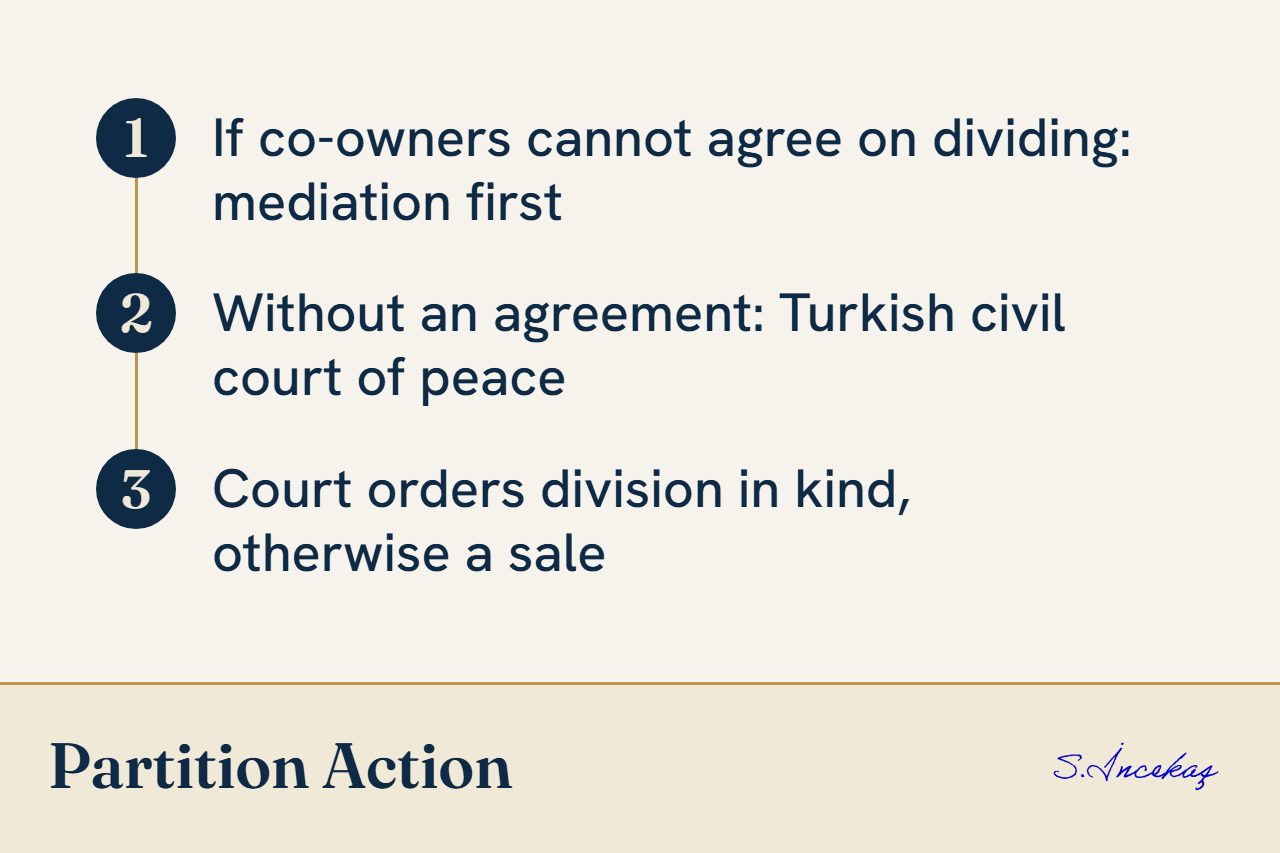
If co-owners of real estate held in shares (hisseli tapu) or heirs who inherited a property together cannot agree on dividing it, they must first apply to a mediator; if mediation ends without an agreement, the partition action (ortaklığın giderilmesi, izale-i şuyu) is filed against all the other co-owners in the civil court of peace where the property is located (Law No. 6325 on Mediation in Civil Disputes, HUAK Article 18/B; Code of Civil Procedure No. 6100, HMK Articles 4(1)(b) and 12(1)). Every co-owner can file this action, however small their share, unless they are bound to keep the property undivided (Turkish Civil Code No. 4721, TMK Article 698; for heirs, Article 642). Where the property is held in shares, however, partition cannot be demanded at an inopportune time (TMK Article 698).
If a co-owner has died, the court does not examine the merits until all the heirs listed in the certificate of inheritance (mirasçılık belgesi) are parties to the case, and it checks this of its own motion at every stage (Court of Cassation, 7th Civil Chamber, decision of 24 February 2026, E.2025/2567, K.2026/1034). As a partition action has no winning or losing side, the litigation costs and the court-awarded attorney’s fee (vekalet ücreti) are, as a rule, borne by the co-owners in proportion to their shares (Court of Cassation, 7th Civil Chamber, decision of 4 December 2025, E.2025/5074, K.2025/5192).
The petition gives the co-owners’ addresses; the title record, the final mediation report and, for inherited property, the certificate of inheritance are attached. Your lawyer represents you at every stage, whether you seek partition or oppose a sale.
Is Co-Owned Property Divided in Kind or Sold?
Co-owned property is divided in kind (aynen taksim) if a co-owner asks for this and it can be divided both legally and physically; any difference in value between the parts is offset in cash. If division is not suitable, in particular because it would significantly reduce the property’s value, the court orders a sale by auction (TMK Article 699).
The subdivision plan prepared by the court-appointed expert (bilirkişi) is submitted for approval under the zoning rules to the municipal executive committee (belediye encümeni) or the provincial administrative board (il idare kurulu); if approval is refused, the court orders a sale (Zoning Law No. 3194, Articles 15 and 16; Court of Cassation, 7th Civil Chamber, decision of 26 May 2025, E.2025/1807, K.2025/2824). As a rule, agricultural land cannot be divided below the minimum agricultural land size or the size that yields an adequate income, and division requires the agriculture ministry’s permission (Law No. 5403 on Soil Protection and Land Use, Articles 8, 8/A and 8/B).
If the deceased died on or after 15 May 2014 and the heirs cannot agree on inherited agricultural land, such as farmland in the Çukurova plain, each heir can also ask for the land to be transferred at its agricultural income value to a qualified heir (ehil mirasçı) who meets the statutory criteria (Law No. 5403, Article 8/C and Provisional Article 5; Court of Cassation, 14th Civil Chamber, decision of 21 January 2021, E.2017/1289, K.2021/226).
If the property is suitable for condominium ownership (kat mülkiyeti) and one co-owner asks for it, the court can convert it into condominium ownership and allocate the independent units to the co-owners (Condominium Law No. 634, KMK Article 10).
Can Only the Heirs Bid in the First Auction of an Inherited Property?
Yes, if all the owners acquired the property by inheritance and no one but the heirs owns it: once partition by sale is ordered, the first auction is held, on a one-time basis, only among the heirs who own the property (Enforcement and Bankruptcy Law No. 2004, İİK Article 114). However, auctions announced before 31 July 2026 remain subject to the former rules (Law No. 7589, Provisional Article 1).
At the heirs-only first auction, a bid must exceed the higher of the property’s full appraised value (muhammen kıymet) and the total of the prior-ranking claims secured by the property, plus the costs of sale and distribution. If a second auction is needed, it is open to everyone, and the same calculation applies with half the appraised value. Heirs, too, must provide security of 10 percent of the appraised value to bid.
The rule gives heirs no general priority or preferential right. If a share has passed to a non-heir, the sale is open to everyone from the start, and an auction limited to the co-owners requires the consent of all of them (TMK Article 699). A sale officer (satış memuru) appointed by the judge conducts the sale (HMK Article 322(2)).
What Are a Property Owner’s Rights in Expropriation and De Facto Expropriation?
Under Turkish law, an owner facing expropriation (kamulaştırma) has two separate routes: an annulment action against the expropriation itself in the administrative courts, and objections to the amount of compensation. If no agreement is reached in the settlement negotiation (uzlaşma görüşmesi), the expropriating authority files an action for determination of compensation and registration (bedel tespiti ve tescil davası) in the civil court of first instance, where the amount is disputed. De facto expropriation (kamulaştırmasız el atma) means physical taking, where property is used without being expropriated, or plan-based restriction, where a zoning plan reserves it for public services. An expropriation lawyer tracks both routes and their deadlines together, starting from the day of service.
The annulment action, and the correction action (düzeltim davası) brought in the ordinary (civil) courts against material errors, must be filed within thirty days of the court’s service on the owner in the compensation case. For an owner who could not be served, the period runs from the newspaper notice replacing service. In co-ownership in shares or joint ownership (elbirliği mülkiyeti), each co-owner can file these actions alone (Expropriation Law No. 2942, Article 14). An owner who files an annulment action must also prove this to the court hearing the compensation case; otherwise, the expropriation becomes final and the property is registered in the expropriating authority’s name at the compensation determined by the court (Article 10).
How Can You Challenge the Amount of Expropriation Compensation?
You challenge the amount within the action for determination of compensation and registration that the expropriating authority files in the civil court of first instance; no separate case is needed (Expropriation Law No. 2942, Article 10). If the property was bought by agreement in the settlement negotiation, no action for increased compensation (bedel artırımı davası) can be brought later (Article 8).
In that action, all defenses and evidence on the property’s value must be submitted in writing within ten days of service of the summons. If the parties do not agree on the amount at the hearing, the judge has court-appointed experts value the property at an on-site inspection (keşif), hears objections to their report and sets fair compensation (Article 10).
Depending on the legal category, land (arazi) is valued by its net income, a building plot (arsa) by comparable sales (emsal) not made for a special purpose, and a building by its construction cost and depreciation; any increase in value from the project requiring the expropriation is disregarded (Article 11). For building plots, the Court of Cassation requires comparable sales made shortly before the valuation date and an opportunity for the parties to submit comparables (Court of Cassation, 5th Civil Chamber, decision of 31 March 2026, E.2025/13261, K.2026/5421).
If only part of the property is expropriated, any loss in value of the remainder is added to the compensation and any increase is deducted, but by no more than half the compensation for the expropriated part (Article 12). Your lawyer examines the valuation report (kıymet takdir raporu) and comparable sales and objects to the experts’ report.
What Can You Claim If Public Authorities Use or Restrict Your Property Without Expropriation?
If a public authority uses your property without expropriating it, you can claim its value or ask for the interference to be stopped (el atmanın önlenmesi), but what applies depends on when the taking occurred. If, instead, an implementation zoning plan (uygulama imar planı) only reserves the property for public services, restricting it in a way that affects the essence of the right of ownership, the authorities must expropriate it or amend the plan to lift the restriction within five years of the plan’s entry into force; otherwise, a compensation claim may arise (Expropriation Law No. 2942, Additional Article 1).
For a physical taking after 4 November 1983, an action for the property’s value is heard by the ordinary (civil) courts (Court of Cassation, 5th Civil Chamber, decision of 16 June 2025, E.2024/10424, K.2025/8886). For a taking between 9 October 1956 and 4 November 1983, the settlement procedure with the authority is a precondition for filing suit; without a settlement, an action for determination of compensation can be filed within three months of the date the record of failed settlement (uzlaşmazlık tutanağı) is drawn up (Provisional Article 6). Property actually allocated to a public service by 8 October 1956 in line with the purposes of the expropriation laws is deemed expropriated; claims relating to it, including compensation claims, raised after 12 January 1963 are not accepted (Provisional Article 20).
In a plan-based restriction case filed in 2025, the Turkish Court of Jurisdictional Disputes (Uyuşmazlık Mahkemesi) held that the ordinary courts had jurisdiction, applying the rule in force when the case was filed (Court of Jurisdictional Disputes, decision of 9 March 2026, E.2026/22, K.2026/141).
What Are Your Rights in Land, Co-Ownership and Neighbor Disputes?
Under Turkish law, the right you can use depends on the type of dispute:
- if your property is being used without a legal basis, an action to prevent interference and compensation for unauthorized use;
- if the boundary on the ground does not match the title plan, fixing the boundary by the plan or a cadastral correction;
- if a co-owner has sold their share to a third party, the right of preemption;
- if your land has no adequate access to a public road, a right of way.
An experienced land lawyer reads the title record, the cadastral record and the timeline of events together and chooses the right route and deadline from the start.
To end co-ownership of property under a shared title, that is, co-ownership in shares (hisseli tapu, paylı mülkiyet), the route is the partition action covered in the partition section.
What Can You Do If Your Neighbor’s Use of Their Property Causes or Threatens Harm?
If a neighbor uses their property in breach of the legal limits on ownership and this causes harm or a threat of harm, you can sue for restoration of the previous situation, removal of the threat and compensation for the harm you have suffered. This includes noise, smoke, dust or smells beyond the level neighbors must tolerate, and excavation or construction work that harms or endangers your property (Turkish Civil Code No. 4721, TMK Articles 730, 737 and 738).
In disputes under neighbor law (komşu hakkı), such as those over a neighbor’s excessive use (taşkın kullanım) of their property or a right of way, you must apply to a mediator before filing suit (Law No. 6325 on Mediation in Civil Disputes, HUAK Article 18/B); details are in the mediation section.
When Can You Sue to Stop Interference With Your Property?
As the owner, you can bring an action to prevent interference (el atmanın önlenmesi, men-i müdahale) against anyone who uses your property without a legal basis, builds on it or prevents you from using it (TMK Article 683). The action is available as long as the interference continues; it is not subject to limitation or to the ten-year period that runs once a cadastral record becomes final (Court of Cassation, 1st Civil Chamber, decision of 13 December 2017, E.2015/5679, K.2017/7298).
You can also bring it against a co-owner who prevents you from using property held in shares; a share in the title record does not in itself mean a specific part of the land (TMK Articles 688 and 693). Use within the scope of a valid lease or easement (irtifak hakkı) is not unlawful interference; evicting a tenant is covered in the rental dispute section.
The case must be filed in the court where the property is located (Code of Civil Procedure No. 6100, HMK Article 12). If a building, wall or other installation has been put up, its removal (kal), restoration of the land and compensation for past use can be claimed in the same case. The title record, photographs and witnesses are the first evidence; an expert lawyer asks the court for an on-site inspection. Interference by public authorities without expropriation is covered in the expropriation section.
When Can You Claim Compensation for Unauthorized Use of Your Property?
If someone not acting in good faith uses your property unlawfully, you can claim compensation for unauthorized use (ecrimisil, haksız işgal tazminatı) for the period of use. The claim is subject to a five-year limitation period, counted as a rule back from the filing date (Court of Cassation, 7th Civil Chamber, decision of 17 February 2026, E.2025/3774, K.2026/866). However, the judge does not apply limitation unless the other side raises it, and steps that interrupted the period, such as earlier enforcement proceedings, are also taken into account (Turkish Code of Obligations No. 6098, TBK Articles 154 and 161).
The claim rests on the duty of a possessor not acting in good faith to compensate for the damage caused and for the produce or income they obtained or neglected to obtain (TMK Article 995). According to the Court of Cassation, this compensation covers a loss at least equal to the rental income; the amount is set at an on-site inspection with a court-appointed expert and, for agricultural land, from official data such as crops, yields and wholesale market prices.
Compensation can be claimed together with an action to prevent interference or in a separate case; the extra condition between co-owners is explained under the next heading. Your lawyer reviews the period of use, the limitation defense and any interrupting steps together.
Can You Claim Compensation If One Co-Owner Uses the Property Alone?
Yes, but as a rule, before the period for which you claim compensation, you must have let that co-owner know that you wish to benefit from the property or its income, a requirement known as intifadan men (Court of Cassation, 7th Civil Chamber, decision of 4 May 2026, E.2026/1787, K.2026/2440). No such notification is needed in these cases:
- Produce, rent or business income: the property yields produce, such as a vineyard or an orchard, or earns income by being rented out, or is itself an income-generating business;
- Denial of shares: the co-owner using the property claims a right to all of it and denies the other co-owners’ shares;
- Use agreement: a use agreement sets out the part each co-owner may use;
- Public property: the property has the legal status of public property (kamu malı);
- Earlier case or enforcement proceedings: before the period for which compensation is claimed, you brought an action to prevent interference, a partition action or a compensation case for unauthorized use, or started enforcement proceedings, against that co-owner concerning this property.
In the same decision, notice was required against a sibling who occupied the whole inherited house; the fact that it was a home did not make notice unnecessary. In that case, the court held that compensation ran from the day the period given in the formal notice sent through a notary (noter ihtarnamesi) expired, not from the date of death.
A co-owner who uses, without dispute, a part corresponding to their share cannot claim compensation; for a co-owner who believes they use less than their share, the Court of Cassation points to a partition action as the route to a definitive solution.

What Can You Do If the Title Plan and the Boundary on the Ground Differ?
If the title plan (tapu planı) and the boundary marks on the ground do not match, the boundary in the plan prevails as a rule, except in areas the competent authorities have designated as landslide zones (TMK Article 719). If a neighbor has crossed that boundary, the remedy is an action to prevent interference.
If a neighbor’s building encroaches on your land, object within fifteen days of learning of it; otherwise, a builder who acted in good faith may, if the circumstances justify it, claim an easement for the encroaching part or ownership of the land under it, for appropriate compensation (Article 725).
If the plan contains an error in measurement, boundary demarcation, drafting (tersimat) or calculation, the cadastre directorate (kadastro müdürlüğü) corrects it. The owners and other right holders have thirty days from service of the correction to bring an action in the civil court of peace to set it aside; otherwise, the correction becomes final. The ten-year period does not apply to this correction procedure (Cadastre Law No. 3402, Article 41).
However, a technical correction does not settle an ownership dispute. During the public posting period, an ownership claim based on a ground predating the cadastre is brought in the cadastral court; once the record is final, such a claim can be raised only within ten years of finalization (Articles 11 and 12; Court of Cassation, 1st Civil Chamber, decision of 3 November 2025, E.2025/3861, K.2025/4762).
How Do You Exercise the Right of Preemption in Co-Owned Property?
If a co-owner sells their share to a third party, the other co-owners exercise their right of preemption (önalım, şufa) by filing an action against the buyer to have the sold share registered in their names (TMK Articles 732 and 734). Preemption cannot be used against a buyer who was already a co-owner of the property before the sales concerned (Court of Cassation, Assembly of Civil Chambers, decision of 1 April 2026, E.2025/216, K.2026/195).
Preemption is excluded in sales by forced auction (cebri artırma) and, for sales made on or after 25 December 2025, also in sales under State Tender Law No. 2886 (TMK Article 733 and Provisional Article 1). A general waiver of preemption must be made in official form and annotated in the land registry; a waiver for a particular sale must be in writing and can be made before or after the sale.
If, before the sale, you and the selling co-owner each actually used separate parts of the property and you did not object to their use, your preemption claim may be held contrary to the principle of honesty and good faith; the mere existence of a part the seller could have used is not enough (Court of Cassation, Assembly of Civil Chambers, decision of 22 October 2025, E.2024/542, K.2025/667).
What Is the Deadline for Filing a Preemption Action?
If the buyer or the seller notified you of the sale through a notary, the action must be filed within three months of that notice being served on you; in any event, it must be filed within one year of the sale. Once either period expires, the right of preemption is lost (TMK Article 733). For sales made before 25 December 2025, when the one-year limit took effect, the former outer limit of two years applies (TMK Provisional Article 1).
Learning of the sale in another way does not start the three-month period; without a notarial notification, only the outer limit runs (Court of Cassation, 7th Civil Chamber, decision of 25 February 2025, E.2024/855, K.2025/1071). The sale date comes from the title record and the notification date from the notary’s service; your lawyer calculates both together and files the case before the deadline expires.
How Is the Price Paid in a Preemption Action?
The holder of the right of preemption must deposit in cash the share’s market value (rayiç bedel), as determined by the judge, together with the land registry costs borne by the buyer. The deposit is made within the peremptory time limit (kesin süre) the judge sets, at the place the judge designates, where it earns interest; otherwise, the share cannot be registered in the claimant’s name. Once the judgment becomes final, the deposit is paid out with its interest to the person entitled (TMK Article 734).
Under the former rule, the deposit consisted of the sale price and the buyer’s land registry costs; the amendment also applies to cases already pending on 25 December 2025 (Provisional Article 1).
According to the Court of Cassation, if the amount is not deposited within the peremptory time limit, the case is dismissed on procedural grounds (Court of Cassation, 7th Civil Chamber, decision of 16 February 2026, E.2025/3310, K.2026/824). The law does not say as of which date the market value is determined: in the same decision, the majority took the filing date for new cases and 25 December 2025 for cases pending on the day of the amendment, while a dissenting opinion argued for the sale date.
The Turkish Constitutional Court (Anayasa Mahkemesi) found the market value rule unconstitutional and annulled the whole paragraph governing the price, together with the transitional paragraph applying it to cases already pending; because the annulment takes effect on 6 August 2027, these provisions remain in force until then (Constitutional Court, decision of 16 July 2026, E.2026/23, K.2026/162). The preemption deadlines (Article 733) are not affected by this annulment.
Can You Claim a Right of Way for Land Without Adequate Road Access?
Yes. An owner whose property has no adequate access to a public road can ask the neighbors for a right of way (geçit hakkı) in return for full compensation (TMK Article 747). In choosing which neighbor must provide it, the law gives priority to the most suitable neighbor in view of the previous ownership and road situation, and then to the one who would suffer the least harm; the necessary right of way (zorunlu geçit) is set by weighing both sides’ interests.
This, too, is a neighbor law dispute: if the case is filed without first applying to a mediator, it is dismissed on procedural grounds; details are in the mediation section. If the parties agree in mediation, an enforceability annotation is obtained from the civil court of peace where the property is located; at either party’s request, the land registry office then registers the right of way after the necessary review, without an official deed being drawn up (Law No. 6325, HUAK Article 18/B).
The title record, the cadastral map (kadastro paftası) and photographs showing the land’s connection to the road are the first documents; your lawyer asks the court to have a court-appointed expert assess the most suitable route and the compensation at the on-site inspection.
What Are Your Options in Condominium Disputes?
Under Turkish law, the route depends on the type of condominium dispute: enforcement proceedings or a lawsuit for unpaid common charges (aidat), an action for annulment against a decision of the unit owners’ assembly (kat malikleri kurulu), and, to amend the management plan (yönetim planı), a vote by the majority the law requires.
For breaches by an owner, such as using a common area exclusively without authorization, carrying out construction, repair or installation work in a common area without the consent the law requires (as a rule, the written consent of four-fifths of all unit owners), or disturbing the neighbors, a unit owner who suffers harm can ask the judge to intervene (hakimin müdahalesi); tenants are bound by the same obligations (Condominium Law No. 634, KMK Articles 18, 19 and 33).
The judge sets a short period for compliance, and the same court imposes an administrative fine (idari para cezası) on anyone who does not comply within that period.
Cases arising under the Condominium Law are heard by the civil court of peace (KMK Additional Article 1), and mediation is mandatory before filing such a lawsuit (Law No. 6325 on Mediation in Civil Disputes, HUAK Article 18/B).
If the unit owners cannot agree on managing the building or appoint a building manager (yönetici), the civil court of peace appoints one at a unit owner’s request (KMK Article 34). An expert lawyer reviews the title record, the management plan and the decision book (karar defteri) to determine the right route, whether mediation is required and the deadline.
How Are Unpaid Common Charges Collected?
The building manager or any other unit owner can pursue the owner in arrears through enforcement proceedings, which require no prior mediation, or through a lawsuit. A unit owner who does not pay their common charges in full must also pay late-payment compensation (gecikme tazminatı) at 5 percent per month for the days of delay (KMK Article 20).
Under KMK Article 37, an operating budget (işletme projesi) that has become final, or an assembly decision on operating expenses, counts as a document under Article 68(1) of the Enforcement and Bankruptcy Law No. 2004 (İİK).
If the debtor objects to enforcement proceedings started without a court judgment, the creditor can ask the enforcement court, within six months, to remove the objection on the basis of such a document. Alternatively, after mandatory mediation ends without agreement, the creditor can sue in the civil court of peace, within one year, to annul the objection. Both periods run from service of the objection on the creditor (İİK Articles 67 and 68; HUAK Article 18/B).
A tenant is also jointly and severally liable (müteselsilen) with the unit owner for the owner’s charges, advances and late-payment compensation, up to the amount of rent the tenant has to pay; any amount the tenant pays is deducted from the rent (KMK Article 22).
If the debt cannot be collected this way either, a statutory mortgage (kanuni ipotek) for the debt determined by the court is registered on the debtor’s independent unit in favor of the other unit owners, at the written request of the building manager or, if there is none, of a unit owner (Article 22).
How Do You Challenge a Decision of the Unit Owners’ Assembly?
A unit owner challenges an assembly decision with an ordinary action for annulment in the civil court of peace where the property is located (KMK Article 33):
- if they attended the meeting and voted against the decision in accordance with Article 32, within one month of the date of the decision;
- if they did not attend, within one month of learning of the decision, and in any event within six months of the date of the decision.
These periods are preclusive: the right to seek annulment lapses when they expire (Court of Cassation, 5th Civil Chamber, decision of 26 March 2024, E.2024/362, K.2024/3734). During the mandatory mediation, these periods stop running from the application to the mediation office until the final mediation report is drawn up, and then resume for the time remaining (HUAK Article 18/A(15)).
No time limit applies to decisions that are non-existent (yok) or absolutely null and void (mutlak butlan); the court examines each decision separately on this point (Court of Cassation, 5th Civil Chamber, decision of 17 March 2025, E.2024/10314, K.2025/3510).
The annulment action can be brought against the building manager as the unit owners’ representative or, in a multi-building complex (toplu yapı), against the manager elected by the relevant board of representatives; if the decision is annulled, the litigation costs are covered as common expenses (KMK Article 38).
If you attend the meeting and vote against a decision, have your dissenting vote and the reasons for it recorded in the decision book, and sign it (KMK Article 32).
What Majority Is Needed to Amend the Management Plan?
In a building not subject to the Condominium Law’s rules on multi-building complexes, the management plan is amended by a vote of four-fifths of all unit owners (KMK Article 28); in a complex subject to those rules, by a vote of two-thirds of the total number of independent units represented by the members of the complex’s board of representatives (Article 70).
Law No. 7579 lowered the threshold for multi-building complexes from four-fifths to two-thirds with effect from 22 May 2026. Provisions of the plan on interim management (geçici yönetim) can likewise be amended by a vote of two-thirds of the owners of the independent units in the complex, and any provisions of management plans that conflict with Article 70 do not apply.
The management plan has the force of a contract binding all unit owners; an amendment also binds those who become owners later, and its date is entered in the declarations section of the condominium register (kat mülkiyeti kütüğü) at the land registry (KMK Article 28).
These majorities do not replace the unanimity the law requires for some matters, such as those in KMK Articles 44 and 45. Annulment of plan provisions that violate mandatory provisions of the law can be sought at any time (Court of Cassation, 5th Civil Chamber, decision of 24 February 2025, E.2024/6414, K.2025/2473). Your lawyer checks the notice convening the meeting, the vote count and the entry at the land registry.
What Should You Check When Buying Real Estate?
Before you buy, check the title record, the zoning and occupancy permit status and the seller’s authority to sell. The sale must be made in official form, and the payment method, the title deed transfer fee (tapu harcı) and other costs should be settled before the transaction. An expert real estate lawyer reviews the title record, the documents and the contract before you sign, preventing a loss of rights from the start.
On the seller’s side, three points are checked. If someone signs on the seller’s behalf, the power of attorney must be drawn up as an official deed (düzenleme şeklinde) and must expressly authorize the transfer of the property (Turkish Code of Obligations No. 6098, TBK Article 504; Notaries Law No. 1512, Article 89). If the seller is married and the property is the family home (aile konutu), the sale requires the other spouse’s express consent (Turkish Civil Code No. 4721, TMK Article 194); the absence of a family home annotation (aile konutu şerhi) does not make this check unnecessary. If you buy a share in co-owned property without already being a co-owner, the other co-owners can exercise their right of preemption (TMK Article 732); the deadline and the price are covered under the preemption heading.
If you buy a flat from a contractor under a contract, without a transfer of title, the construction-for-flats section explains the conditions affecting your rights.
What Should You Check in the Title Record Before Buying?
In the current title record, check who owns the property and in what shares, whether it is under a construction servitude or condominium ownership, registered rights such as a mortgage, annotations such as an attachment (haciz), an interim injunction, a promise-to-sell agreement or a lease, and entries in the declarations section (TMK Articles 1008 to 1012).
An old title deed document (tapu senedi) does not show later entries; a current copy of the record should be obtained from the land registry office immediately before signing. No one can claim not to know of an entry in the land registry (TMK Article 1020).
A sale does not by itself remove a mortgage: if the debt is not paid, the creditor can still have the property sold and recover the claim from the proceeds (TMK Articles 873 and 888).
Once annotated, attachments, injunctions, promise-to-sell agreements and leases can also be asserted against anyone who later acquires a right in the property (TMK Articles 1009 and 1010); the difference between an injunction prohibiting transfer and a pending-litigation annotation is explained in the title cancellation section.
A buyer of a tenanted property becomes a party to the lease even without an annotation; the purchase does not automatically evict the tenant (TBK Article 310). How a new owner can seek eviction on grounds of need is covered in the rental dispute section.
Your lawyer reads each entry together with the underlying registry documents.
How Do You Check the Zoning and Occupancy Permit Status?
Check the zoning status, the building permit, the approved project and the occupancy permit with the relevant municipality or the authority competent to issue the permit. As a rule, a building without an occupancy permit receives no electricity, water or sewerage services until one is obtained; however, because the law allows temporary connections in some cases, a utility subscription alone does not show that an occupancy permit was issued (Zoning Law No. 3194, Articles 30 and 31 and Provisional Articles 11 and 16).
If the title record shows a construction servitude, an occupancy permit may not yet have been issued for the whole building; once it is, the land registry converts the construction servitude into condominium ownership of its own motion, subject to the statutory conditions (Condominium Law No. 634, KMK Articles 3 and 10).
If there is no occupancy permit, first find out whether one can be obtained: no permit is issued while the building does not conform to its building permit and its annexes, and a contract cannot cure this (Zoning Law, Article 30). If it can be obtained, the contract should state who will obtain it, by when and at whose cost.
Your lawyer compares the documents with the title record and the contract; where needed, a technical expert checks whether the building conforms to the project and is safe.
In What Form Must a Property Sale or a Promise to Sell Be Made?
A property sale must be made in official form at the land registry office or before a notary, and ownership passes on registration; a promise-to-sell agreement must be drawn up by a notary as an official deed and does not by itself transfer ownership (TMK Articles 705 and 706; TBK Article 237; Notaries Law, Articles 61/A and 89). As a rule, a private written agreement or one with a notarized signature only is not valid, and the price paid can be reclaimed as unjust enrichment (TBK Article 77).
If a promise-to-sell agreement is annotated in the land registry and no sale is made within five years of the annotation, the law provides for its deletion by the land registry office of its own motion; this period concerns the annotation, not the agreement itself (TMK Article 1009; Land Registry Law No. 2644, Article 26).
Under the Regulation on Real Estate Trade (Taşınmaz Ticareti Hakkında Yönetmelik), using the secure payment system (güvenli ödeme sistemi) is scheduled to become mandatory on 1 December 2026, and the Turkish Ministry of Trade (Ticaret Bakanlığı) can extend this date by up to three months.
Once its use is mandatory, if some or all of the price in a sale within its scope is to be paid in cash, by bank transfer (havale or EFT) or by another method specified by the Ministry, the sale price must be paid through this system, which is designed to ensure that the price and ownership change hands simultaneously. If a bank or a financing or savings financing company (tasarruf finansman şirketi) finances part or all of the price, the system is used for the payments other than the financed amount (Additional Article 1 and Provisional Article 1 of the Regulation).
How Are the Title Deed Transfer Fee and Sale Costs Calculated?
The title deed transfer fee is charged to the buyer and the seller separately, at 2 percent (binde 20) of the actual sale price each; that price must be declared, and if it is lower than the property tax value (emlak vergisi değeri), the fee is calculated on that value instead (Fees Law No. 492, Article 63 and Tariff No. 4). If the declared price is later found not to reflect the actual price, or the fee is found to have been paid on less than the property tax value, the fee on the difference is assessed together with a tax loss penalty (vergi ziyaı cezası) equal to that fee (Article 63).
A land registry revolving fund fee (döner sermaye ücreti) is also charged; it is calculated with a regional coefficient, which in Adana varies from district to district (Law No. 6083 on the Land Registry and Cadastre Revolving Fund, Article 8). If the sale is made before a notary, a notary fee is also payable (Notaries Law, Article 61/A). In an ordinary sale, a property with unpaid property tax cannot be transferred (Property Tax Law No. 1319, Article 30).
For buildings subject to compulsory earthquake insurance (zorunlu deprem sigortası), the seller’s policy ends on registration and the land registry office checks for a policy in the buyer’s name; the buyer should therefore take out a policy in their own name before the transaction (Disaster Insurance Law No. 6305, Article 11; General Conditions of Compulsory Earthquake Insurance, Clause C.4).
How Long Does a Real Estate Case Take in Adana?
There is no fixed duration for a real estate case in Adana; it depends on the type of case and the court hearing it. According to the 2025 annual activity report of the Adana Justice Commission (Adana Adalet Komisyonu), the average durations reported for partition actions at the Adana Courthouse, for example, ranged from about five months to four years, depending on the court. These are court averages, not a forecast for a new case, and they do not cover the time until the judgment becomes final, including any appeals.
The report gives each court’s average duration for the ten case types it handled most often and no single average for Adana as a whole. The table shows the lowest and highest of the averages reported for individual courts at the Adana Courthouse in 2025:
| Case type | Reporting court | Lowest and highest court average, 2025 |
|---|---|---|
| Cancellation of title and registration (preemption) | Civil court of first instance | 157 to 652 days (about 5 to 21 months) |
| Cancellation of title and registration (sham transfer by the deceased) | Civil court of first instance | 237 to 879 days (about 8 months to 2.5 years) |
| Partition action (co-ownership in shares) | Civil court of peace | 165 to 1,143 days (about 5 months to 3 years) |
| Partition action (inherited property) | Civil court of peace | 164 to 1,525 days (about 5 months to 4 years) |
| Rent determination action | Civil court of peace | 231 to 566 days (about 8 to 19 months) |
| Eviction action | Civil court of peace | 210 to 466 days (about 7 to 15 months) |
| Action to prevent interference (including subtypes) | Civil court of first instance | 209 to 885 days (about 7 months to 2.5 years) |
| Compensation for unauthorized use | Civil court of first instance | 558 to 779 days (about 18 months to 2 years) |
| Determination of expropriation compensation and registration | Civil court of first instance | 384 to 947 days (about 13 months to 2.5 years) |
| Compensation for de facto expropriation | Civil court of first instance | 588 to 797 days (about 19 months to 2 years) |
| Cases under Condominium Law No. 634 | Civil court of peace | 684 days (reported by one court; about 22 months) |
| Action for annulment of the objection (unpaid common charges) | Civil court of peace | 206 days (reported by one court; about 7 months) |
Source: Adana Justice Commission, 2025 annual activity report, pages 69 to 81 (numbered civil courts of first instance and civil courts of peace at the Adana Courthouse). A figure reported by one court is that court’s average, not a range. A court that did not list a case type among its ten most common has no figure for it in the report.
At the Initial Consultation, we review your documents and give you a time estimate specific to your case.
Which Stages Make a Real Estate Case Take Longer?
The main stages that can lengthen a real estate case are the on-site inspection and expert examination, serving documents on the parties and co-owners, compliance with the court’s interim decisions, and appeals. The duration of mediation before filing a case is covered in the mediation section.
The time given to a court-appointed expert to prepare the report cannot exceed three months; at the expert’s request, the court can extend it by up to three months, stating its reasons. Under the simple procedure (basit yargılama), which applies, for example, to cases within the jurisdiction of the civil court of peace, both limits are two months (Code of Civil Procedure No. 6100, HMK Articles 274 and 316).
In an expropriation case for determination of compensation and registration, the court-appointed experts must submit their report on the property’s value within fifteen days (Expropriation Law No. 2942, Article 10).
In a partition action, all co-owners must be parties to the case, so tracing addresses and serving co-owners abroad can add time.
If the party who requested an on-site inspection or expert examination does not pay the advance within the peremptory time limit set by the court, and the other party does not pay it instead, the requesting party is deemed to have waived the taking of that evidence; different rules apply in matters the parties cannot freely dispose of (HMK Article 324).
As a rule, judgments on rights in rem over immovable property, such as cancellation of title and registration, cannot be enforced until they become final, so an appeal to the regional court of appeal (istinaf) or to the Court of Cassation (temyiz) can postpone registration (HMK Articles 350 and 367). Where co-owned property is partitioned by sale, distributing the proceeds can take further time.
Complete documents and correctly identified parties reduce delays; before filing, your lawyer obtains the title record and identifies any heirs and the parties’ addresses.
How Are a Real Estate Lawyer’s Fees and Court Costs Determined in Adana?
A real estate lawyer’s fee in Adana is agreed freely in a contract with the lawyer, but it cannot be lower than the Minimum Attorney Fee Tariff (AAÜT); court fees (harç) and other litigation costs are calculated under the law and official tariffs and vary with the type of case and the value of the property. The court-awarded attorney’s fee, which the other side is ordered to pay at the end of the case, is also a litigation cost; it is separate from the fee agreed with your lawyer and is calculated under the tariff (Code of Civil Procedure No. 6100, HMK Article 323).
Before filing, an expert real estate lawyer calculates the court fees, advances and the lawyer’s fee for your case, preventing delays caused by a shortfall in court fees or advances. Setting out in writing at the Initial Consultation what the fee covers and which costs are expected also prevents disputes later.
Which Court Fees and Costs Are Paid in a Real Estate Case?
When a case is filed, the filing fee and the advance on costs (gider avansı) are paid, and in cases with a monetary value, one quarter of the judgment and writ fee (karar ve ilam harcı), calculated on the value given in the statement of claim, is also paid in advance (Fees Law No. 492, Article 28; HMK Article 120). Evidence costs, such as those of an on-site inspection or a court-appointed expert, are deposited during the proceedings (HMK Article 120).
In cases such as an action for cancellation of title and registration or an action to prevent interference, the judgment and writ fee is calculated on the value of the property or share in dispute, and in an eviction action on one year’s rent (Fees Law, Articles 16 and 17). The main 2026 amounts are:
| Item | 2026 amount or rate |
|---|---|
| Filing fee, civil court of peace | TRY 335.20 |
| Filing fee, civil court of first instance | TRY 732.00 |
| Judgment and writ fee, case with a monetary value | 6.831 percent of the value granted in the judgment |
| Judgment and writ fee, case without a monetary value or dismissed case | TRY 732.00 |
| Judgment and writ fee, partition by sale | 1.138 percent of the sale price |
| Judgment and writ fee, partition by division in kind | 0.455 percent of the value of the divided property |
| On-site inspection fee, excluding expert fees | TRY 5,188.00 |
For example, in an action for cancellation of title over a property in Adana worth TRY 2,000,000, the advance judgment and writ fee alone comes to TRY 34,155. If the value established during the proceedings is higher than the value given in the statement of claim, the hearing at which this becomes clear goes ahead, but the case cannot proceed further unless the advance fee on the difference is paid by the next hearing (Fees Law, Article 30).
Any unused part of the advance on costs is refunded once the judgment becomes final (HMK Article 333).
Following the Constitutional Court’s annulment decisions, no advance judgment and writ fee is collected in a compensation case for de facto expropriation if the defendant is exempt from court fees. If the defendant is not exempt, these decisions do not affect the advance payment rule, but the one-month period for paying the balance no longer runs from service of the judgment (Fees Law, Article 28).
How Is the Attorney’s Fee Agreed in a Real Estate Case?
The attorney’s fee is agreed freely between the lawyer and the client, but it cannot be lower than the Minimum Attorney Fee Tariff (Attorneys’ Act No. 1136, Articles 163 and 164; AAÜT Article 1). In cases whose value cannot be measured in money, this minimum is a fixed amount: under the tariff published on 3 November 2026, TRY 40,000 before the civil court of peace and TRY 62,000 before the civil court of first instance.
In cases whose value can be measured in money, such as cancellation of title, the minimum is calculated on that value in decreasing bands (16 percent on the first TRY 800,000) and cannot be lower than the fixed amount for the court hearing the case (AAÜT Article 13). In partition and division actions, however, the minimum is a fixed TRY 52,000, regardless of the property’s value.
The fee can also be agreed as a percentage of the value, up to 25 percent; however, such an agreement cannot give the lawyer part of the property in dispute in kind. If there is no written fee agreement or the fee is unclear, in matters whose value can be measured in money, the fee is set at 10 to 20 percent of the value of the part won as of the date the judgment becomes final, and not below the tariff (Attorneys’ Act, Article 164).
If You Win the Case, Does the Other Side Pay Attorney’s Fees?
As a rule, yes: if you are represented by a lawyer, the court orders the losing party to pay the court-awarded attorney’s fee under the tariff, along with the court fees and other litigation costs (HMK Articles 323, 326 and 330). By law, the court-awarded attorney’s fee belongs to the lawyer (Attorneys’ Act, Article 164); whether it is deducted from the fee agreed with your lawyer should be stated clearly in the fee agreement.
The court-awarded attorney’s fee cannot be less than the tariff amount or more than three times that amount; in cases whose value can be measured in money, it is calculated using the tariff’s bands and cannot exceed the amount granted or dismissed. In an eviction action, it is based on one year’s rent, and in a rent determination action on one year’s difference in rent (AAÜT Articles 3, 9 and 13). The tariff in force on the date of the judgment applies (Attorneys’ Act, Article 168).
If the case is partly won, the costs are divided in proportion to each side’s success; this apportionment does not apply in compensation cases for de facto expropriation or in claims for non-pecuniary damages (HMK Article 326). If your case is dismissed, you may be ordered to pay the other side’s court-awarded attorney’s fee; if a compensation claim is dismissed in full, this fee is the fixed amount for the court hearing the case (AAÜT Articles 10 and 13). How costs are shared in a partition action is covered in the partition section.
What Documents Should You Bring to Your Initial Consultation With a Real Estate Lawyer in Adana?
Bring the title record or the title deed document you have, your ID, and any contract, formal notice (ihtarname), document served on you (tebligat) or correspondence about the dispute. These are enough for the first assessment, and the Initial Consultation can go ahead even if some documents are missing; gathering them or waiting for an appointment does not stop a deadline that is already running. Depending on your matter, the following are also useful:
| Your matter | Bring if you have them |
|---|---|
| Title cancellation and registration | Official deed, the power of attorney used for the sale, payment records |
| Construction-for-flats agreement | The agreement and its annexes, the building permit and the project plans, handover and land share transfer documents |
| Rental dispute | Lease agreement, payment records, notices, written undertaking to vacate |
| Partition action | The known addresses of the co-owners; for inherited property, the certificate of inheritance |
| Expropriation and de facto expropriation | Letters from the expropriating authority or the court, the valuation report, photographs of any physical taking |
| Land, co-ownership and neighbor disputes | Cadastral record or map, photographs, witness details; for preemption, the notification of the share sale sent through a notary |
| Condominium disputes | Management plan, the unit owners’ assembly decision or a copy of the relevant decision book entry, operating budget, statement of common charges |
| Before buying real estate | Zoning status, building permit, occupancy permit, the draft contract or draft promise-to-sell agreement |
Keep documents served on you and notices sent to you through a notary, together with their envelopes or records of electronic service (elektronik tebligat). The periods to challenge an expropriation, object to a payment order or appeal a judgment can start running from service (Expropriation Law No. 2942, Article 14; Enforcement and Bankruptcy Law No. 2004, İİK Article 62; Code of Civil Procedure No. 6100, HMK Article 345). If a case or enforcement proceedings are pending, also give us the name of the court or enforcement office and the case number. At the Initial Consultation, an expert real estate lawyer reviews the documents, calculates the running periods and tells you where to obtain the missing ones.
The Initial Consultation takes place at our office or online; our online legal consultation service is offered separately. We give a first reply on the same day you send your request, including weekends and outside office hours. That is our response time, not how long a case or a land registry transaction takes; case durations are covered in the duration section.

What Do People Frequently Ask a Real Estate Lawyer in Adana?
Does a Real Estate Case Require Special Authority in the Power of Attorney?
No special authority is needed to file and conduct the case: a general power of attorney for litigation is enough (Code of Civil Procedure No. 6100, HMK Article 73). Acts such as settling, applying for mediation, amending the whole claim, waiving the claim or appeals, accepting the other side’s claim and delegating to another lawyer need express authority in the power of attorney (HMK Article 74). Your lawyer files a power of attorney drawn up or certified by a notary (HMK Article 76).
Can a Property Case in Adana Be Handled While You Are Abroad?
Yes: your lawyer handles it in Adana with a power of attorney, which a Turkish consulate may issue (Notaries Law No. 1512, Article 191). One from a foreign notary, unless exempt, can be used with an apostille if the Apostille Convention applies between the issuing state and Turkey, otherwise with local and Turkish consular certification (HMK Article 224). It needs a Turkish translation if it is not in Turkish (HMK Article 223). Have your lawyer check the powers and certification first.
