
A termination notice handed to you one morning, wages paid late for months, overtime that was never paid or the uncertainty that follows an occupational accident: as an employment lawyer in Adana, we protect your rights in these disputes from the very first step.
In employment disputes, time limits are short and the order of steps matters. In most cases, a lawsuit cannot be filed without first applying to a mediator; to seek reinstatement, you must apply to a mediator within one month of being served with the termination notice.
If you are asked to sign a release agreement (ibraname), a mutual termination agreement (ikale) or a resignation letter, have it reviewed first. At the Initial Consultation, we go through your documents with you, work out the deadlines already running and decide on the route to take from the start.
Choose the option that matches your situation to go to the relevant section.
My wages or overtime are not being paid
I want to quit but I am afraid of losing my rights
I worked without social security registration or my work was underreported
How Can an Employment Lawyer in Adana Help You?
An employment lawyer in Adana handles the review before filing, mandatory mediation meetings where required, the lawsuit and the appeal stages in a dispute arising from an employment contract, and calculates the time limits so that no rights are lost. Our main areas of work include:
- Severance pay, pay in lieu of notice and compensation for bad-faith termination.
- Reinstatement mediation and lawsuits.
- Claims for unpaid wages, overtime and leave pay.
- The employee’s termination for just cause.
- Workplace mobbing and discrimination.
- Disputes over union rights and collective labor agreements.
- Compensation for occupational accidents and occupational diseases.
- Establishing unregistered or underreported work.
- For employers: employment contracts, the termination process, administrative fines imposed by the Turkish Social Security Institution (Sosyal Güvenlik Kurumu, SGK) and work permits for foreign employees.
In separate matters, we act for either the employee or the employer. Attorney Saim İncekaş is registered with the Adana Bar Association (registration no. 4293).
Cases of employees who work for a public institution under an employment contract are also covered by this service; we handle status disputes of civil servants and contract personnel in our administrative law practice, and the criminal aspect of an occupational accident in our criminal law practice. Enforcement proceedings (icra takibi) to collect an award are a separate stage.
What Rights Does an Employee Have After Being Dismissed or Leaving a Job?
An employee’s rights when a job ends depend on how the employment contract ended and may include statutory severance pay (kıdem tazminatı), pay in lieu of notice (ihbar tazminatı) and reinstatement (işe iade). If the employer terminated the contract although none of the breaches of the rules of morality and good faith (ahlak ve iyiniyet kurallarına aykırı haller) listed in Article 25(II) of Labor Law No. 4857 (İş Kanunu) actually occurred, an employee with at least one year of service is entitled to severance pay. An employee who leaves of their own accord is entitled to severance pay only if there is a reason listed in the law, such as termination for just cause (haklı neden). An employer who ends an indefinite-term contract without just cause and without giving notice owes pay in lieu of notice.
An employee covered by statutory job security (iş güvencesi) may also seek reinstatement if the termination is not based on a valid reason (geçerli sebep); the time limit for this starts to run when the termination notice is served.
Unpaid wages, overtime (fazla çalışma, fazla mesai) and pay for unused annual leave can be claimed whatever the type of termination (Labor Law, Articles 32 and 59).
An experienced employee rights lawyer in Adana first reviews the reason given in the termination notice, the length of service, the number of employees at the workplace and the date the notice was served; we do this in a meeting at our office or online.

Who Is Entitled to Severance Pay?
An employee with at least one year of service is entitled to severance pay if the employment contract ends in one of the following ways listed in the law:
- Termination by the employer for a reason other than the breaches of the rules of morality and good faith in Article 25(II) of the Labor Law.
- Termination by the employee for just cause.
- Compulsory military service (muvazzaf askerlik).
- Leaving to receive an old-age, retirement or disability pension, or a lump-sum payment (toptan ödeme).
- Leaving after completing the retirement conditions other than age, that is, the required insurance period and number of social security contribution days.
- A female employee leaving of her own accord within one year of the date of her marriage.
- The employee’s death, in which case the severance pay goes to the statutory heirs.
Separate periods of work for the same employer are added together only if each period ended in a way that gives a right to severance pay; an earlier period that ended by resignation without a reason listed in the law is therefore not counted (Turkish Court of Cassation, 9th Civil Chamber, decision of 5 December 2024, E.2024/13177, K.2024/15864). Under the same decision, a period settled by paying severance pay in full is also excluded, while a qualifying period for which severance pay was paid only in part or not at all is added. The decision also states that if the employer raises the statute of limitations and the break after the earlier period exceeded the limitation period, severance pay cannot be calculated for that earlier service; the limitation periods are covered in the section on statutes of limitations and critical deadlines in employment cases. The legal basis is Article 14 of the former Labor Law No. 1475, which remains in force; its references to the termination provisions of the former law are deemed to refer to Articles 24 and 25 of the Labor Law (Labor Law, Provisional Article 1).
Can an Employee Who Resigns Receive Severance Pay?
As a rule, an employee who resigns of their own accord cannot receive severance pay; they can if they have at least one year of service and the departure rests on a reason listed in the law, such as termination for just cause, compulsory military service, retirement or a female employee’s marriage. According to the Turkish Court of Cassation (Yargıtay), any claim that the resignation was signed under pressure is examined first; if there is none, an employee who clearly states a specific reason in the termination notice is generally bound by that reason, while one whose resignation states no reason may prove the real reason for leaving. How to state the reason is covered in the section on how a notice of termination for just cause should be given.
An employee who leaves to receive an old-age pension or a lump-sum payment must document that they are entitled to it and have applied to the institution they are insured with (Law No. 1475, Article 14). An employee who shows, with a letter from the Social Security Institution (SGK), that the conditions other than age have been met and then leaves does not lose the right to severance pay by later working in another job (Court of Cassation, Assembly of Civil Chambers, decision of 14 November 2019, E.2016/1419, K.2019/1183). A female employee exercises this right within one year of the date of her official marriage; the employer’s consent and a notice period are not required, and a resignation given before the marriage does not create this right (Court of Cassation, 9th Civil Chamber, decision of 26 March 2024, E.2024/4245, K.2024/5687).
Is Severance Pay Due When a Fixed-Term Employment Contract Ends?
The mere expiry of the term does not give rise to severance pay; severance pay is due if the employer has made clear that it will not renew the contract and has no just cause for not renewing it, and the employee has at least one year of service (Court of Cassation, Assembly of Civil Chambers, decision of 1 April 2015, E.2013/1943, K.2015/1131). If it is the employee who declines renewal without just cause, no severance pay arises; pay in lieu of notice does not apply to a fixed-term contract in any case (Court of Cassation, Assembly of Civil Chambers, decision of 1 November 2023, E.2023/197, K.2023/1038). Successive fixed-term contracts made without an essential reason are treated as indefinite-term from the start (Labor Law, Article 11).
How Is Severance Pay Calculated?
Severance pay equals thirty days’ wages for each full year of service, and any remaining period of less than a year is paid at the same rate. The calculation is based on the last wage plus the benefits in money, or measurable in money, that the employee receives under the contract or by law; this is called the gross wage including regular benefits (giydirilmiş brüt ücret) (Law No. 1475, Article 14). Bonuses, recurring incentive payments, meal, transport, clothing, fuel and rent allowances and private health or life insurance premiums paid by the employer are included; payments that do not recur are not (Court of Cassation, 9th Civil Chamber, decision of 15 April 2026, E.2026/1109, K.2026/3237).
The thirty-day period can be increased in the employee’s favor by contract, but the amount paid for each year of service cannot exceed the severance pay cap. If severance pay is not paid on time, the court awards interest at the highest rate paid on bank deposits. For example, an employee who has worked four years and seven months receives four times thirty days’ gross wage including regular benefits, plus a proportionate amount for the seven months; if thirty days’ wage exceeds the cap, the cap is used for each year.
Which Date Determines the Severance Pay Cap?
The cap in force on the date the employment contract is terminated applies; if the employer terminated by giving a notice period, the cap in force when that period ends is used. If the employer dismissed an employee entitled to pay in lieu of notice without giving the notice period and without paying that compensation, the employee can also benefit from a cap increase that takes effect during the notice period that should have been given (Court of Cassation, 9th Civil Chamber, decision of 18 April 2022, E.2022/1486, K.2022/4601). The cap is the maximum retirement bonus payable for one year of service to the highest-ranking civil servant (Law No. 1475, Article 14). The amount is announced by a circular of the Turkish Ministry of Treasury and Finance (Hazine ve Maliye Bakanlığı); from 1 July to 31 December 2026, it is TRY 73,729.87 per year of service.
How Is Pay in Lieu of Notice Calculated?
Pay in lieu of notice equals the wages for the notice period and is paid by the party that ends an indefinite-term employment contract without just cause and without observing that period. The statutory notice period depends on the employee’s length of service:
- Two weeks for an employee with less than six months of service.
- Four weeks for an employee with six months to one and a half years of service.
- Six weeks for an employee with one and a half to three years of service.
- Eight weeks for an employee with more than three years of service.
These periods are minimums and can be extended by contract; the employer may also terminate by paying the wages for the notice period in advance. The calculation uses the gross wage including regular benefits (Labor Law, Article 17). Neither party can claim pay in lieu of notice when the contract is terminated for just cause, or when the employee leaves for retirement, compulsory military service or marriage in a way that gives a right to severance pay (Labor Law, Articles 24 and 25; Court of Cassation, 9th Civil Chamber, decision of 10 October 2022, E.2022/8804, K.2022/11613).
For example, an employee with four years of service who is dismissed without just cause and without notice can claim eight weeks of gross wage including regular benefits as pay in lieu of notice.
Can an Employee Without Statutory Job Security Claim Compensation for Bad-Faith Termination?
Yes. If the contract of an employee working under an indefinite-term contract and outside the scope of statutory job security is terminated through an abuse of the right to terminate, the employee is entitled to compensation for bad-faith termination (kötüniyet tazminatı) equal to three times the wages for the notice period; if the notice period was not observed either, pay in lieu of notice can also be claimed (Labor Law, Article 17). Those outside statutory job security are mainly the employees of an employer with fewer than thirty employees, counting all its workplaces in the same branch of activity together, and employees with less than six months of service, unless they work underground (Labor Law, Article 18).
According to the Court of Cassation, a termination made because the employee complained about the employer, sued it or testified as a witness is in bad faith. The employee claiming the compensation must prove the bad faith: where the employer’s bad faith had not been proven, the Court of Cassation held that the claim should have been dismissed rather than accepted (Court of Cassation, 9th Civil Chamber, decision of 23 January 2013, E.2010/39493, K.2013/2642). An employee covered by statutory job security cannot claim this compensation; their protection against termination is through reinstatement.
Can an Employee Who Signs a Mutual Termination Agreement Receive Compensation?
If the employee proposed the mutual termination agreement (ikale), whether severance pay and pay in lieu of notice are paid depends on what the parties agreed. If the employer proposed it, the Court of Cassation requires that the employee also be given an additional benefit, known as a reasonable benefit (makul yarar), on top of the severance pay and notice pay amounts. A mutual termination agreement ends the employment contract by mutual consent rather than by unilateral termination; for this reason, a valid agreement does not automatically bring the severance pay, notice pay and reinstatement consequences that attach to a unilateral termination.
If the employer proposed the agreement and no reasonable benefit was provided, the contract cannot be said to have ended by mutual agreement (Court of Cassation, 9th Civil Chamber, decision of 20 January 2026, E.2025/6890, K.2026/406). A mutual termination agreement does not extinguish the wage, overtime and unused annual leave claims accrued up to that day, and a release clause in the agreement must meet the legal requirements for a release agreement. Having your severance pay and notice pay calculated before signing the offer shows whether the additional benefit is genuinely being provided.
Is a Release Agreement Signed When Leaving the Job Valid?
A release agreement (ibraname) signed when leaving the job is absolutely null and void: it is valid only if, on the date it is signed, at least one month has passed since the employment contract ended (Turkish Code of Obligations No. 6098, TBK Article 420). A valid release agreement must also be in writing and clearly state the type and amount of the claim being released, and the full amount due must be paid through a bank.
A release agreement, or a payment document containing a release statement, that does not show that the full amount due was paid has the effect of a receipt only for the amount it shows; even then, the payment must have been made through a bank. However, the invalidity of a release agreement does not cancel a payment that was actually made: a payment not made through a bank also extinguishes the debt in whole or in part as performance if it is proven, but its mere mention in the document is not enough (Court of Cassation, 9th Civil Chamber, decision of 12 March 2025, E.2024/15000, K.2025/2564).
The one-month period is only a condition for the release; it does not give the employer a right to delay payment, and wages must be paid in full when the contract ends (Labor Law, Article 32). Before signing, compare each claim item and amount in the release agreement with the payments you actually received.
How Does the Reinstatement Process Work?
For an employee covered by statutory job security, the reinstatement process starts with mediation: the employee must apply to a mediator (arabulucu) within one month of being served with the termination notice, and if no agreement is reached, a reinstatement lawsuit can be filed with the Turkish labor court (iş mahkemesi). In the lawsuit, the employer must prove that the termination was based on a valid reason; an employee who claims that it was based on a different reason must prove that claim (Labor Law No. 4857, Article 20).
The judgment can be appealed (istinaf) to the Turkish regional court of appeal (bölge adliye mahkemesi), whose decision is final under Article 8 of Labor Courts Law No. 7036 (İş Mahkemeleri Kanunu). Once the judgment is final, the employee must apply separately to the employer to return to work; an employer that does not reinstate the employee must pay compensation for failure to reinstate (işe başlatmama tazminatı).
Note the date on which you received the written termination notice or were dismissed orally, and keep any termination notice and your SGK service record (hizmet dökümü) at hand. An experienced reinstatement lawyer reviews the reason given for the termination, checks whether you were given an opportunity to defend yourself (savunma) and works out the day the deadline expires.
What Are the Conditions for Filing a Reinstatement Lawsuit?
An employee with at least six months of service whose indefinite-term contract was terminated by the employer can file a reinstatement lawsuit, claiming that the termination was not based on a valid reason, if the employer has at least thirty employees in total at its workplaces in the same branch of activity as the employee’s workplace. The six months are calculated by combining periods of work for the same employer, and the six-month requirement does not apply to employees working underground (Labor Law, Article 18).
A valid reason must be connected with the employee’s capacity or conduct, or based on the requirements of the business, the workplace or the work; circumstances such as union membership, pregnancy, giving birth or applying to administrative or judicial authorities against the employer to pursue one’s rights are not valid reasons. The termination must be notified in writing, stating the reason clearly and precisely; where the valid reason relates to the employee’s conduct or performance, the employee must first be given an opportunity to defend themselves against the allegations (Labor Law, Article 19).
An employer’s representative (işveren vekili) who manages the business as a whole, and their deputies, as well as an employer’s representative who manages an entire workplace and has the authority to hire and dismiss employees, are not covered by statutory job security; according to the Court of Cassation, a job title alone is not enough, and what matters is the actual authority (Court of Cassation, 9th Civil Chamber, decision of 13 October 2020, E.2020/3073, K.2020/11570).
When Must You Apply to a Mediator and to the Court for Reinstatement?
The employee must apply to a mediator with a reinstatement request within one month of being served with the termination notice; if no agreement is reached, a lawsuit can be filed with the labor court within two weeks of the date the final mediation report (son tutanak) was drawn up. If the parties agree, the dispute can instead be taken to a special arbitrator (özel hakem) within the same period (Labor Law, Article 20).
The one-month period runs from the service of the termination notice, not from the end of the notice period, even if the employer terminated the contract by giving a notice period; the Court of Cassation has also accepted this for an employee working abroad (Court of Cassation, 9th Civil Chamber, decision of 17 June 2020, E.2020/978, K.2020/5774). An employee dismissed orally or de facto without a written notice should not wait for a document; the period may start to run from that day.
If a reinstatement lawsuit is filed without first applying to a mediator and is dismissed on procedural grounds for that reason, the employee can apply to a mediator within two weeks of being served with the final decision dismissing the lawsuit, which the court serves on its own initiative. In every case, do not leave the mediation application to the last day.
What Happens If You Win a Reinstatement Lawsuit?
If the court rules that the termination is invalid, the employee must apply to the employer to return to work within ten working days of being served with the final judgment. If the employer does not reinstate the employee within one month of the application, it must pay compensation for failure to reinstate of at least four and at most eight months’ wages.
Whether or not they are reinstated, an employee who applies in time with a genuine intention to return to work receives wages and other entitlements for up to four months not worked until the judgment becomes final (boşta geçen süre ücreti). The court determines the compensation for failure to reinstate and these wages and other entitlements as specific sums, based on the wage at the date the lawsuit was filed (Labor Law, Article 21).
If the employee does not apply in time, or does not return to work despite a genuine invitation from the employer, the original termination is treated as valid: these two payments cannot be claimed, but pay in lieu of notice and severance pay are still owed if their conditions are met (Court of Cassation, 9th Civil Chamber, decision of 4 February 2026, E.2025/9530, K.2026/799).
If the employee is reinstated, any pay in lieu of notice and severance pay received in advance are deducted from the payment for the period not worked; an employee who is not reinstated receives pay in lieu of notice only if, at the original termination, the notice period was not given and the wages for it were not paid in advance (Labor Law, Article 21).
How Can You Claim Unpaid Wages, Overtime and Leave Pay?
To claim unpaid wages, overtime pay, pay for work on the weekly rest day or on national and public holidays, or pay for unused annual leave, you must first apply to a mediator. If no agreement is reached, these employment-related monetary claims (işçilik alacakları) can be brought before the labor court (Labor Courts Law No. 7036, Article 3). Wages and pay for rest days and holidays can be claimed even while the employment contract continues; pay for unused annual leave, by contrast, becomes due when the contract ends and is also paid to an employee who resigns (Labor Law No. 4857, Article 59).
Every item to be claimed should be identified in full when the statement of claim is drafted. A claim that does not appear in the statement of claim at all, for example a type of payment that was never requested, cannot be added to the lawsuit later through a partial amendment (kısmen ıslah) (Court of Cassation, Grand General Assembly for the Unification of Judgments, decision of 8 May 2026, E.2021/8, K.2026/1). Increasing the amount of a claim that is already in the statement of claim is subject to separate rules. An experienced employee rights lawyer calculates each item separately from payslips (bordro), bank records and workplace entry and exit records.
Article 107 of the Code of Civil Procedure No. 6100 (HMK) was repealed by Law No. 7589, so a new action for an unquantified claim (belirsiz alacak davası) can no longer be filed; the former provision continues to apply to actions filed before 31 July 2026. If the amount cannot be fully determined at the outset, a partial claim (kısmi dava) can be filed for part of it, and the amount claimed can be increased once in the same lawsuit until the evidence stage (tahkikat) ends (Code of Civil Procedure, Article 109(4)).
What Can an Employee Do If Their Salary Is Not Paid?
If wages remain unpaid twenty days after the payment date, unless this is due to force majeure (mücbir sebep), the employee can refrain from work (iş görmekten kaçınma). An employee who stops working for this reason cannot be dismissed on that ground or replaced by a new employee, and this is not treated as a strike even if it becomes collective. Wages must be paid at least once a month, and wages not paid on time carry interest at the highest rate paid on bank deposits (Labor Law, Articles 32 and 34).
If the employer does not calculate or pay wages in accordance with the law or the employment contract, the employee also has the right to terminate the contract for just cause (Labor Law, Article 24(II)(e)); the law does not require a twenty-day wait for this termination. How this termination must be notified and the deadline for it are covered in the section on how an employee can terminate the employment contract for just cause. Keep the bank statements for the unpaid months, your payslips and your correspondence with the employer.
How Is Overtime Pay Calculated?
Work beyond forty-five hours a week is overtime, and each overtime hour is paid at the normal hourly wage plus 50 percent; where the contract sets a shorter working week, work above it and up to forty-five hours is paid at the normal hourly wage plus 25 percent. For example, ten hours of overtime for an employee whose gross hourly wage is TRY 100 come to TRY 100 × 1.5 × 10 = TRY 1,500 gross. Instead of the increased pay, the employee may choose time off in lieu (serbest zaman): one and a half hours for each overtime hour, or one hour and fifteen minutes for each hour worked at the 25 percent rate (Labor Law, Article 41).
Where the parties agree on averaging of working time (denkleştirme), working time may not exceed eleven hours a day, and weeks of more than forty-five hours are not overtime as long as the weekly average over the averaging period stays within the normal weekly working time. The averaging period is two months and can be extended up to four months by a collective labor agreement (toplu iş sözleşmesi); in tourism it is four months and can be extended up to six months by a collective labor agreement (Labor Law, Article 63). Even if the weekly total is not exceeded, work beyond eleven hours a day, or, as a rule, beyond seven and a half hours at night, is treated as overtime (Court of Cassation, 9th Civil Chamber, decision of 1 July 2020, E.2016/19455, K.2020/6892); rest breaks are not counted toward these limits.
Can You Claim Pay for Overtime Beyond 270 Hours a Year?
Yes. The law limits overtime to 270 hours a year in total and requires the employee’s consent to work overtime (Labor Law, Article 41); according to the Court of Cassation, this limit exists to protect the employee, and exceeding it does not prevent the employee from claiming the increased pay for the hours above it.
A clause in the employment contract stating that overtime pay is included in the salary has only limited effect: the agreed basic wage must be above the minimum wage, the wage level must be high enough to cover the overtime included in it, and payments must actually have been made on that basis. Even then, the clause covers at most 270 hours a year; if the employee worked for less than a year, this limit is reduced according to the number of months worked, and overtime above it is paid separately (Court of Cassation, 9th Civil Chamber, decision of 15 April 2026, E.2026/1116, K.2026/3241).
How Is Overtime Proven?
The employee must prove that overtime was worked, and the employer must prove that it was paid (Court of Cassation, 9th Civil Chamber, decision of 8 April 2021, E.2021/3660, K.2021/7752). The employee can prove overtime with documents such as workplace entry and exit records, timesheets (puantaj) and correspondence, or with witnesses. If the employee relies on records kept by the employer, the employer must submit them; if it does not do so within the peremptory time limit (kesin süre) set by the court and shows no acceptable excuse, the court may accept the employee’s statement about the content of those records (Code of Civil Procedure, Articles 219 and 220).
Does a Signed Payslip Bar an Overtime Claim?
A signed payslip can limit how additional overtime is proven, but it does not in itself rule out the claim.
If overtime pay is calculated and shown on a payslip that the employee signed without adding a note of objection (ihtirazi kayıt), overtime beyond what it shows for that period can be proven only with written evidence. If a note of objection was added to the payslip, or if the payslip is unsigned and payments that include overtime pay were made through a bank in varying amounts each month, overtime can be proven by any kind of evidence, including witnesses (Court of Cassation, 9th Civil Chamber, decision of 14 April 2026, E.2025/9077, K.2026/3186).
How Is Overtime Proven Through Witnesses?
A witness must be someone who knows, or could know, the employee’s working pattern at the workplace; a coworker cannot have first-hand knowledge (görgüye dayalı bilgi) of periods in which they did not work with the employee, so a coworker’s account is assessed only for the period they worked together (Court of Cassation, 9th Civil Chamber, decision of 14 April 2026, E.2025/9077, K.2026/3186). When the calculation is based on witness testimony, the court makes a reasonable deduction (makul indirim), based on the presumption that the employee did not work continuously through days of leave, illness and holidays (Court of Cassation, Assembly of Civil Chambers, decision of 22 November 2022, E.2021/660, K.2022/1574).
As a rule, the testimony of employees who have themselves sued the employer is not relied on; if there is corroborating evidence (yan deliller), their statements are assessed together with the other evidence (Court of Cassation, Assembly of Civil Chambers, decision of 16 June 2020, E.2019/353, K.2020/403). Witnesses should therefore be people who can describe concretely in which period and how they saw the employee’s working hours.
How Much Is an Employee Paid for Working on the Weekly Rest Day?
An employee who works on the weekly rest day (hafta tatili) is paid one and a half days’ wages on top of the one day’s wages due for that day even without work. The Court of Cassation treats this work as overtime paid at a 50 percent increase; for an employee on a fixed monthly wage, the one day’s pay for the rest day is already included in that wage (Court of Cassation, Assembly of Civil Chambers, decision of 15 April 2021, E.2016/2387, K.2021/504). A collective labor agreement may set different pay for this work. To be entitled to the weekly rest day, the employee must have worked, or be legally deemed to have worked, on the working days before it; such an employee is given an uninterrupted rest of at least twenty-four hours within each seven-day period and is paid in full for the rest day on which they do not work (Labor Law, Article 46).
In tourism-certified accommodation facilities (turizm işletmesi belgeli konaklama tesisleri), the weekly rest day can be given within the four days following the day on which it was earned, at the employee’s written request or consent; in that case, the part of the work done on the rest day that equals the normal daily working time is not counted as overtime. The employee can withdraw their consent by notifying the employer in writing thirty days in advance.
How Much Is an Employee Paid for Working on National and Public Holidays?
An employee who works on a national or public holiday (ulusal bayram ve genel tatil günleri) instead of taking the day off is paid an additional day’s wages for each day worked, on top of the wages for that day; an employee who does not work is paid in full for that day (Labor Law, Article 47). Whether work is done on these days is decided by the collective labor agreement or the employment contract; if the contract contains no provision on this, the employee’s consent is required (Labor Law, Article 44).
The national holiday begins at 1:00 p.m. on 28 October and continues throughout 29 October. The public holidays are the official holidays of 23 April, 19 May and 30 August, the Ramadan Feast (Ramazan Bayramı), which lasts three and a half days, and the Feast of Sacrifice (Kurban Bayramı), which lasts four and a half days, both starting at 1:00 p.m. on the eve of the feast, as well as 1 January, 1 May and 15 July (Law No. 2429 on the National Holiday and General Holidays, Articles 1 and 2).
When Is Pay for Unused Annual Leave Due?
Pay for unused annual leave is due when the employment contract ends, for whatever reason. The annual leave the employee earned but did not use is paid at the wage on the date the contract ended, to the employee or the employee’s rightful beneficiaries (hak sahipleri), and the statute of limitations (zamanaşımı) for this pay also starts on that date (Labor Law, Article 59). The right to paid annual leave cannot be waived (Labor Law, Article 53). The employer must prove that the leave was used, with a signed leave register (izin defteri) or an equivalent document (Court of Cassation, 9th Civil Chamber, decision of 21 April 2026, E.2026/3048, K.2026/3581).
How Many Days of Paid Annual Leave Does an Employee Get by Length of Service?
An employee who has worked at the workplace for at least one year, including the probationary period (deneme süresi), is entitled to paid annual leave; the leave cannot be shorter than the periods below, which depend on length of service (Labor Law, Article 53).
| Length of service or age | Minimum annual leave |
|---|---|
| One to five years (including five years) | 14 days |
| More than five and less than fifteen years | 20 days |
| Fifteen years or more | 26 days |
| Employees aged eighteen or younger, or fifty or older | 20 days |
The twenty-day minimum based on age does not reduce a longer leave earned through length of service. For employees working underground, each period is increased by four days; the periods can also be extended by the employment contract or a collective labor agreement. The annual leave provisions of the Labor Law do not apply to employees in seasonal or campaign work (mevsimlik ya da kampanya işleri) that by its nature lasts less than a year.
Who Is Liable for a Subcontracted Worker’s Claims?
The principal employer (asıl işveren) is liable together with the subcontractor (alt işveren, taşeron) to the subcontractor’s employees for obligations relating to that workplace that arise from the Labor Law, the employment contract or a collective labor agreement to which the subcontractor is a party (Labor Law, Article 2). According to the Court of Cassation, this is joint and several liability (müteselsil sorumluluk), so a claim within this scope can be brought against either employer or both; an amount that has been paid cannot be collected twice (Court of Cassation, 9th Civil Chamber, decision of 13 October 2021, E.2021/9540, K.2021/14240; Turkish Code of Obligations No. 6098, Articles 163 and 166). A subcontracting relationship can be set up for ancillary work (yardımcı işler) at the workplace, or for parts of the main work that require expertise because of the requirements of the business and the work and for technological reasons.
If the principal employer’s own employees were taken on by the subcontractor and their rights were restricted, if a subcontracting relationship was set up with someone who previously worked at that workplace, or if the relationship is otherwise a sham arrangement (muvazaa), that is, one based on an appearance that conceals the real situation, the subcontractor’s employees are treated as employees of the principal employer from the start. The employer names in the SGK service record and the workplace entry records are used to establish the nature of the relationship and whom to sue.
How Can an Employee Terminate the Employment Contract for Just Cause?
If one of the just causes listed in the law exists, an employee can terminate the employment contract in writing, without observing the notice period or, in a fixed-term contract, waiting for the term to end (Labor Law No. 4857, Articles 24 and 109). This termination for just cause differs from an ordinary resignation: it entitles an employee with at least one year of service to severance pay (Article 14 of the former Labor Law No. 1475, which remains in force). An employee who terminates for just cause cannot claim pay in lieu of notice, but can still claim unpaid wages, overtime pay and pay for unused annual leave. The notice should state the reason for termination clearly.
Which Situations Give an Employee the Right to Terminate for Just Cause?
The law lists the employee’s just causes in three groups: health reasons, breaches of the rules of morality and good faith, and compelling reasons (zorlayıcı sebepler) that require work at the employee’s workplace to stop for more than one week (Labor Law, Article 24).
A health reason exists if the nature of the work makes it dangerous to the employee’s health or life, or if the employer or another employee with whom the employee is in constant, close and direct contact contracts a contagious disease or one incompatible with the employee’s work.
The second group includes the following conduct by the employer: misleading the employee about an essential point of the contract when it is made; using words or engaging in conduct that offends the honor of the employee or a member of their family (şeref ve namusa dokunan), or attacking or intimidating them; and sexually harassing the employee. It also includes failing to calculate or pay wages in accordance with the law or the contract, failing to comply with the working conditions, and failing to take the necessary measures after the employee has reported that another employee or a third party sexually harassed them at the workplace.
Claims for overtime pay and for pay for work on the weekly rest day and on national and public holidays are also wage claims in the broad sense (Court of Cassation, 9th Civil Chamber, decision of 14 April 2021, E.2021/3906, K.2021/8106). Underpayment of social security contributions also gives the employee just cause (Court of Cassation, 9th Civil Chamber, decision of 8 March 2021, E.2017/23786, K.2021/5715).
What Is the Deadline for Terminating Employment for Just Cause?
A termination based on a breach of the rules of morality and good faith must be made within six working days after the employee learns of the conduct and, in any event, within one year after the conduct took place (Labor Law, Article 26); these time limits do not apply to health reasons or compelling reasons.
In a continuing breach (süregelen ihlal), such as unpaid wages or underpaid social security contributions, these time limits do not run while the breach continues; according to the Court of Cassation, the right to terminate can be exercised until payment is made (Court of Cassation, 9th Civil Chamber, decision of 9 September 2019, E.2016/6122, K.2019/15301). Because a termination made after payment may not be treated as justified, the notice should not be delayed.
If the employee misses the time limit and also leaves an indefinite-term contract without observing the notice period, the employee may owe the employer pay in lieu of notice even though there was just cause (Court of Cassation, 9th Civil Chamber, decision of 10 October 2022, E.2022/8804, K.2022/11613).
How Should a Notice of Termination for Just Cause Be Given?
Any notice that ends the employment contract must in every case be given in writing (Labor Law, Article 109). The notice should state the reason for termination clearly and specifically, because, according to the Court of Cassation, an employee who states a specific reason is, as a rule, bound by that reason (Court of Cassation, 9th Civil Chamber, decision of 10 May 2022, E.2022/4884, K.2022/5756). The notice can be delivered by hand with a signed acknowledgment of receipt (imza karşılığı elden teslim) or sent through a notary as a notarial notice (noter ihtarnamesi).
If just cause is not proven, the severance pay claim based on it is dismissed (Law No. 1475, Article 14); in an indefinite-term contract, if the notice period was not observed either, the employer can claim pay in lieu of notice (Labor Law, Article 17). For this reason, before giving notice, make sure the reason is supported by documents: for example, bank statements and payslips for unpaid wages, the SGK service record for social security contributions, and correspondence for other reasons. An experienced employment lawyer carries out this review and prepares the notice.
Is Mediation Mandatory Before Filing an Employment Lawsuit?
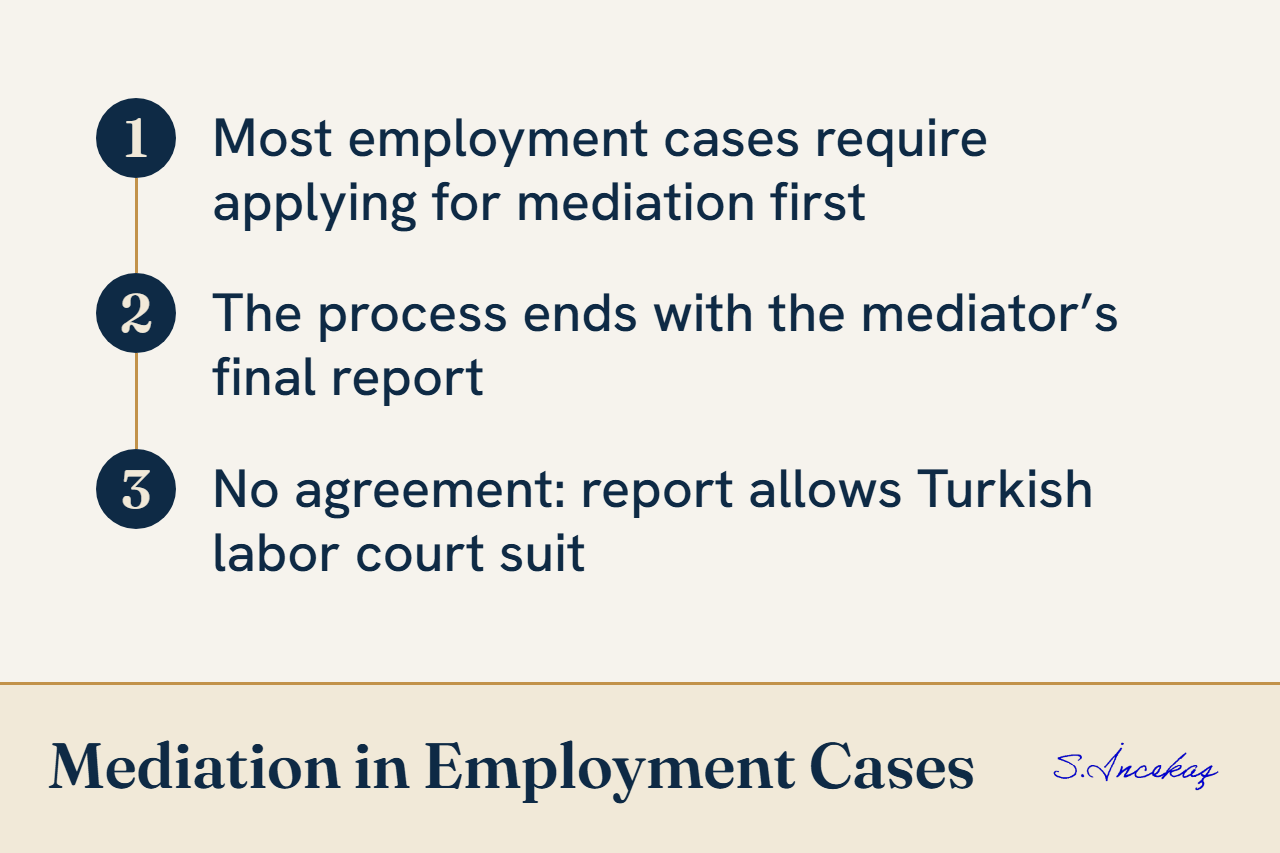
In most employment cases, yes: under Turkish law, applying to a mediator is a precondition for filing suit (dava şartı) in lawsuits over an employee’s or employer’s monetary claims and compensation based on the law, an individual employment contract or a collective labor agreement, and in reinstatement lawsuits (Labor Courts Law No. 7036, Article 3). The rule also covers actions for annulment of an objection in enforcement proceedings (itirazın iptali), negative declaratory actions (menfi tespit) and actions for restitution (istirdat) concerning these claims; compensation lawsuits arising from occupational accidents and occupational diseases, however, fall outside it.
Applying is mandatory, but reaching an agreement is not (Article 3 of Law No. 6325 on Mediation in Civil Disputes, HUAK); if no agreement is reached, a lawsuit can be brought before the labor court with the final mediation report.
In Which Employment Cases Is Mediation Not Mandatory?
Applying to a mediator is not mandatory in lawsuits for pecuniary and non-pecuniary damages arising from an occupational accident or occupational disease, or in declaratory, objection and recourse actions (tespit, itiraz ve rücu davaları) related to them (Labor Courts Law, Article 3). An action to establish unregistered employment (hizmet tespit davası), which covers both fully unreported work and unreported days, is not among the lawsuits listed in the law either, because it is not a lawsuit over a monetary claim or compensation; this is covered in the section on unregistered or underreported work.
For social security lawsuits brought against the Social Security Institution (SGK) in the labor court, the precondition is not mediation but a prior application to the Institution; requests to establish compulsory insurance periods for work under an employment contract are outside this requirement as well (Labor Courts Law, Article 4). This is covered in the section on which court hears an employment case in Adana.
Where Do You Apply for Mediation?
You apply to the mediation office (arabuluculuk bürosu) in the place where the other party is domiciled or where the work was performed. If there is more than one other party, the domicile of any one of them is enough, and where no mediation office has been set up, the application is made to the court registry designated for this purpose (Labor Courts Law, Article 3). This means that even if the employer’s headquarters is in another province, you can apply in Adana for work performed in Adana. The office appoints the mediator from its list; if the parties agree on a mediator on the list, that mediator is appointed.
The parties can attend the meetings in person or through their legal representatives or lawyers; an employee authorized by the employer in writing can also represent the employer and sign the final report. In the application, give the other party’s correct name (for a company, its trade name) and address, your own contact details and any others you have for that party, and each claim item sought. An experienced employment lawyer calculates the amounts claimed, prepares the application and represents you in the meetings.
How Long Does Mandatory Mediation Take?
The mediator must complete the mediation within three weeks of being appointed; in cases of necessity, the mediator can extend this period by up to one week (Labor Courts Law, Article 3). The mediator draws up the final report when the meetings end, with or without an agreement, when the parties cannot be reached or when no meeting can be held because they do not attend; if no agreement is reached, the original of this report or a copy certified by the mediator must be attached to the statement of claim.
How the time spent in mediation affects the statute of limitations is covered in the section on statutes of limitations and critical deadlines.
What Happens to a Party Who Does Not Attend the First Mediation Meeting?
If mediation ends because one party fails to attend the first meeting without a valid excuse, that party is named in the final report. In the lawsuit that follows, even if it wins in part or in full, it is held liable for half of the court costs (yargılama giderleri) that the other party is required to pay, and only half of the court-awarded attorney’s fee (vekalet ücreti) is awarded in its favor (Labor Courts Law, Article 3). If mediation ends because neither party attends the first meeting, each bears its own court costs in the later lawsuit.
What Happens to an Employment Lawsuit Filed Without Mediation?
If an employment lawsuit that requires mediation is filed without first applying to a mediator, the court dismisses it on procedural grounds for lack of a precondition, without taking any further step. If mediation ended without an agreement before the lawsuit was filed but the final report was not attached to the statement of claim, the court gives a one-week final deadline to submit it; if it is not submitted in time, the lawsuit is dismissed on procedural grounds without the statement of claim being served on the other party (Labor Courts Law, Article 3).
The requirement is examined separately for each claim. According to the Court of Cassation, only the part of the lawsuit that concerns a claim not included in the final report, or a period for which payment fell due after the report, is dismissed on procedural grounds, and those claims require a new application to a mediator (Court of Cassation, 9th Civil Chamber, decision of 16 June 2025, E.2025/3259, K.2025/5034). If the report describes the dispute only in general terms, what matters is whether the claim was actually negotiated: dismissing claims for severance pay and overtime pay despite indications that they had been negotiated violated the right of access to a court (Turkish Constitutional Court, decision of 18 May 2026, application no. 2023/33449). To avoid this dispute, ask the mediator to list each claim item one by one before you sign the report.
For reinstatement, the time limit for applying to a mediator again after a procedural dismissal is covered in the section on how the reinstatement process works.
Can You Still Sue After Reaching a Settlement in Mediation?
For matters resolved by a valid agreement, no: the parties cannot sue over what they agreed on (Law No. 6325, Article 18). Claims raised in mediation but left unresolved can still be brought before the labor court with the final report. According to the Court of Cassation, the agreement is a contract, so its invalidity can be claimed if it was made through excessive benefit (aşırı yararlanma), material error, fraud or duress (Court of Cassation, 10th Civil Chamber, decision of 2 July 2025, E.2024/15140, K.2025/11206). Excessive benefit means a clearly disproportionate settlement obtained by exploiting the injured party’s distress, thoughtlessness or inexperience. These grounds must be relied on within one year: for error or fraud, from its discovery; for duress, from when its effect ends; for excessive benefit, from when the injured party realizes their thoughtlessness or inexperience or their distress ends, and in any event within five years of the agreement (Turkish Code of Obligations No. 6098, Articles 28 and 39).
An agreement document signed by the parties, their lawyers and the mediator can be enforced like a court judgment (ilam niteliğinde belge) without an enforceability annotation (icra edilebilirlik şerhi); other agreement documents can be enforced in the same way once the court grants the annotation (Law No. 6325, Article 18).
If the parties agree that the employee will return to work, the agreement must specify the date of return, the amount of wages and other entitlements for the period not worked, and the amount of compensation payable if the employee is not taken back; otherwise, no agreement is deemed to have been reached. If the employee does not start work on the agreed date, the termination becomes valid (Labor Law No. 4857, Article 21).
Which Court Hears an Employment Case in Adana?
In Adana, employment cases are, as a rule, heard by the labor court. In the central districts, the labor courts at the Adana Courthouse (Adana Adliyesi) hear them, and each new lawsuit is allocated to one of these courts. Subject-matter jurisdiction (görev) determines the type of court; venue (yetki) determines where the lawsuit is filed. Because a lawsuit in the wrong court costs time, a lawyer experienced before the labor courts checks both before filing.
Labor courts hear civil disputes arising from the employment relationship between employees and employers or employers’ representatives. They also hear disputes under labor and social security legislation to which the Social Security Institution (SGK) or the Turkish Employment Agency (Türkiye İş Kurumu, İŞKUR) is a party, with statutory exceptions such as objections to administrative fines (Labor Courts Law No. 7036, Article 5).
In places outside the judicial district of any labor court, for example at the Karataş Courthouse, the civil court of first instance (asliye hukuk mahkemesi) hears employment cases under the procedures of the Labor Courts Law (Article 2). However, under a Court of Cassation decision unifying case law (içtihadı birleştirme kararı), lawsuits for breach of a post-employment non-compete clause (rekabet yasağı) go to the commercial court of first instance (asliye ticaret mahkemesi), not the labor court (Court of Cassation, Grand General Assembly for the Unification of Judgments, decision of 13 June 2025, E.2023/1, K.2025/3). The competent Turkish court or authority and the mediation requirement for common disputes are as follows:
| Dispute | Competent court or authority | Mediation mandatory before filing? |
|---|---|---|
| Monetary claims and compensation of an employee or employer (for example, severance pay, pay in lieu of notice, wages, overtime pay or pay for unused annual leave) | Labor court | Yes |
| Reinstatement | Labor court | Yes |
| Compensation for an occupational accident or occupational disease | Labor court | No |
| Action to establish unregistered employment | Labor court | No |
| Social security lawsuit against the Social Security Institution (SGK) | Labor court as a rule; disputes covered by the transitional rules for the former civil servants’ retirement fund (Emekli Sandığı) go to the administrative courts | No; for labor court cases, an application to SGK is required first |
| Challenge to an administrative fine imposed by SGK | Administrative court; an objection can first be made to SGK | No |
| Breach of a post-employment non-compete clause | Commercial court of first instance | Yes, in lawsuits whose subject is a sum of money (Turkish Commercial Code No. 6102, Article 5/A) |
| Status disputes of civil servants and contract personnel under Article 4/B of Civil Servants Law No. 657 | Administrative courts | No |
Where Can You File an Employment Case?
You can file an employment case where the defendant is domiciled on the filing date, or where the work was performed or the transaction took place. If there is more than one defendant, you can also file where any one of them is domiciled. A compensation lawsuit arising from an occupational accident can also be filed where the accident or the damage occurred, or where the injured employee is domiciled. Venue agreements (yetki sözleşmesi) that conflict with these rules are invalid; naming another city’s court in the employment contract does not bind the employee (Labor Courts Law, Article 6).
For example, an employee dismissed while working in Adana who then moves to another city can sue for unpaid wages in Adana, where the work was performed, or where the employer is domiciled; moving away does not, by itself, make the new city a proper venue for that claim.
Must You Apply to the Social Security Institution Before Suing It?
Generally, yes: in social security disputes before the labor court, you must apply to the Institution before suing it. Requests to establish compulsory insurance periods for work under an employment contract, that is, actions to establish unregistered employment, are exempt. If the Institution does not respond within sixty days, the request is deemed rejected, without prejudice to time limits in other laws; you can sue only after the request is rejected or deemed rejected. The time spent on the application is not counted toward forfeiture periods (hak düşürücü süre) or the statute of limitations (Labor Courts Law, Article 4).
A court applies the statute of limitations only if a party raises it (Turkish Code of Obligations No. 6098, Article 161). When a forfeiture period expires, the right itself is lost, and the court takes this into account even if neither party raises it.
Is a Public Sector Employee’s Case Heard by the Labor Court?
Yes, if they work for a public institution under an employment contract: the labor court hears their employment-related monetary claims and reinstatement requests (Labor Courts Law, Article 5). Workers employed through a subcontractor who were transferred under Decree Law No. 696 to the institution’s permanent worker positions (sürekli işçi kadrosu) have also acquired the status of the institution’s own permanent employees (Court of Cassation, Assembly of Civil Chambers, decision of 18 November 2021, E.2021/405, K.2021/1445).
For public servants whose status is governed by administrative law, such as civil servants and contract personnel under Article 4/B of Civil Servants Law No. 657 (4/B sözleşmeli personel), disputes arising from that status are heard by the administrative courts (idari yargı), not the labor court (Administrative Procedure Law No. 2577, Article 2). By law, these contract personnel are not regarded as employees (Civil Servants Law, Article 4). Working in the public sector does not by itself determine which courts have jurisdiction: what matters is whether the person is an employee, a civil servant or contract personnel, and what the claim is about.
What Are Your Rights Against Workplace Mobbing or Discrimination?
An employee subjected to psychological harassment at work (mobbing, psikolojik taciz) can ask the employer for protection without leaving the job; the employer must take the necessary measures to prevent the harassment. If the employer has breached this duty, an employee who proves the mobbing can also claim non-pecuniary damages (manevi tazminat) and compensation for any resulting pecuniary loss they prove (Turkish Code of Obligations No. 6098, Article 417). In the case of discrimination, even a single instance of unequal treatment on a prohibited ground can give rise to a claim for discrimination compensation.
An employee can also terminate the employment contract for just cause on the basis of mobbing and, with at least one year of service, claim severance pay (Article 14 of the former Labor Law No. 1475, which remains in force; Court of Cassation, 9th Civil Chamber, decision of 15 December 2021, E.2021/12218, K.2021/16601). As a rule, an employee must apply to a mediator before suing the employer for compensation for mobbing or discrimination; if no agreement is reached, a lawsuit can be filed with the labor court (Labor Courts Law No. 7036, Articles 3 and 5).
In one case, the Court of Cassation considered a manager’s conduct rude but short of psychological harassment and upheld the judgment, stating that unpaid overtime entitled the employee to severance pay (Court of Cassation, 9th Civil Chamber, decision of 1 April 2026, E.2026/423, K.2026/2895). For this reason, the termination notice should also state any other just cause. The notice, the binding effect of the stated reason and the deadlines are covered in the section on termination for just cause.
Which Behaviors Count as Mobbing (Psychological Harassment)?
According to the Court of Cassation, mobbing requires that an employee be targeted and that the conduct extend over a certain period and become systematic; the aim is often to make the employee leave the job (Court of Cassation, Assembly of Civil Chambers, decision of 9 February 2021, E.2016/1427, K.2021/53). A few unfair, rude or discourteous acts that occur occasionally, without continuity, do not by themselves count as mobbing. However, an employer that offends the employee’s honor by words or conduct, attacks them or intimidates them gives the employee just cause for termination even if this happens only once; this is covered in the section on termination for just cause.
The Assembly of Civil Chambers of the Turkish Court of Cassation (Yargıtay Hukuk Genel Kurulu) gives examples such as burdening the employee with work beyond their capacity, cutting off communication with them, deliberately not inviting them to social events, constantly criticizing them and scolding them in a raised voice, belittling and looking down on them, assigning them work unsuited to their position or area of expertise, and withholding authority to which they are entitled. Some of these acts may not be unlawful when taken individually; what makes them mobbing is the systematic, repeated pattern they form. Mobbing can come from coworkers as well as from superiors, and the employer’s duty to take preventive measures applies in both cases.
How Is Mobbing Proven?
The employee must prove mobbing, but the Court of Cassation considers an approach called approximate proof (yaklaşık ispat) suited to the nature of the matter. Because psychological harassment usually occurs between the harasser and the victim, this approach takes account of the typical course of events and general rules of experience. In one case, emails, health board reports and witness testimony were among the evidence showing strong facts that the employer could not rebut, and mobbing was found to have occurred (Court of Cassation, Assembly of Civil Chambers, decision of 4 October 2018, E.2015/2274, K.2018/1428).
The events the employee describes must nevertheless be consistent, and there must be a strong indication of mobbing (kuvvetli emare); in another case, witness testimony given in general terms and unsupported by other evidence was found insufficient (Court of Cassation, Assembly of Civil Chambers, decision of 9 February 2021, E.2016/1427, K.2021/53).
For this reason, note who did what as events occur, with the date, the place and those present. Keep the correspondence, submit complaints to the employer or human resources in writing and, if you sought medical help, obtain the reports. An experienced employment lawyer matches the events with the evidence and assesses whether they support termination for just cause and compensation claims.
What Can an Employee Who Faces Discrimination at Work Claim?
An employee who faces discrimination in the employment relationship or when it ends can claim appropriate compensation of up to four months’ wages, known as discrimination compensation (eşit davranmama tazminatı, ayrımcılık tazminatı), as well as the rights they were denied (Labor Law No. 4857, Article 5).
The same article prohibits discrimination in the employment relationship based on language, race, color, sex, disability, political opinion, philosophical belief, religion, sect and similar grounds. Unless there is an essential reason, the employer may not treat a part-time employee differently from a full-time employee, or a fixed-term employee differently from an indefinite-term employee. Unless biological reasons or the nature of the work require them, direct or indirect differences in treatment because of sex or pregnancy are prohibited at every stage from the making of the employment contract to its end. No lower wage may be agreed because of sex for the same work or work of equal value.
As a rule, the employee must prove the violation; however, if they show facts strongly indicating that a violation is likely, the employer must prove that there was none. The reinstatement route for an employee covered by statutory job security who is dismissed for a discriminatory reason is explained in the section on how the reinstatement process works.
How Are Disputes Over Union Rights and Collective Labor Agreements Resolved?
Under Turkish law, an employee must generally apply to a mediator before suing over union compensation (sendikal tazminat), reinstatement or monetary claims under a collective labor agreement; if mediation ends without agreement, they can file a lawsuit with the labor court (Labor Courts Law No. 7036, Articles 3 and 5).
Collective bargaining (toplu görüşme) has its own procedure: if the union and the employer cannot agree, one of them reports the dispute to the competent authority (görevli makam), which appoints an official mediator (resmi arabulucu). For a workplace-level collective agreement (işyeri toplu iş sözleşmesi), the competent authority is the Adana Provincial Directorate of Labor and Employment Agency (Adana Çalışma ve İş Kurumu İl Müdürlüğü) if the workplace is in Adana (Law No. 6356 on Trade Unions and Collective Labor Agreements, Articles 2, 49 and 50).
Hiring cannot be made conditional on joining or not joining a union. An employee cannot be dismissed or treated differently because of union membership or non-membership, or for taking part in union activities outside working hours or, with the employer’s permission, during working hours. Differences in wages, bonuses, incentive payments or monetary social benefits under a collective labor agreement do not by themselves amount to union-related discrimination (Law No. 6356, Article 25).
Under the same article, an employee who faces union-related discrimination while employed can claim union compensation of at least one year’s wages. As a rule, the employee must prove the discrimination, but if they show facts strongly indicating it, the employer must prove the reason for its conduct.
What Can an Employee Dismissed for Union-Related Reasons Claim?
An employee dismissed for union-related reasons (sendikal neden) can claim union compensation of at least one year’s wages. This requires neither a reinstatement lawsuit nor an application to the employer after a reinstatement judgment. Union compensation is awarded whether or not the employer reinstates the employee; if the employer does not, compensation for failure to reinstate is not awarded in addition (Law No. 6356, Article 25). In a dispute involving hourly pay, the Court of Cassation held that the one-year minimum is the gross daily base wage (günlük çıplak brüt ücret) multiplied by 365 (Court of Cassation, 9th Civil Chamber, decision of 4 November 2024, E.2024/10265, K.2024/14468).
Since the Turkish Constitutional Court (Anayasa Mahkemesi) annulled part of Article 25, the statutory job security conditions of at least thirty employees, six months of service and an indefinite-term contract no longer apply to union compensation. The Court of Cassation has also accepted that an employee with less than six months of service can seek reinstatement if the union-related reason is proven (Court of Cassation, 9th Civil Chamber, decision of 18 January 2018, E.2016/33460, K.2018/636). For reinstatement, the employee must apply to a mediator within one month of being served with the termination notice (Labor Law No. 4857, Article 20).
The employer must prove the reason it gave for the dismissal; an employee who claims that the real reason was union-related must prove it (Law No. 6356, Article 25). The Court of Cassation looks at factors such as the number of union members at the workplace, when employees joined or left the union, whether the union’s bargaining authorization process (yetki süreci) was under way in the same period, and whether non-union employees replaced those dismissed (Court of Cassation, 9th Civil Chamber, decision of 19 February 2026, E.2025/10071, K.2026/1513).
What Can You Do If Rights Under a Collective Labor Agreement Are Not Honored?
If a wage difference, bonus or social benefit due to an employee under a collective labor agreement is not paid, the employee must first apply to a mediator; if mediation ends without agreement, they can sue for payment in the labor court (Labor Courts Law, Article 3). From the date of default (temerrüt), these claims under the agreement carry interest at the highest rate applied to business loans (Law No. 6356, Article 53).
Employees who are members of the signatory union on the signing date benefit from the agreement as of its effective date; those who join later benefit as of the date the union notifies the employer of their membership. Employees who are not members of that union can also benefit, as of the date of their request, by paying it solidarity dues (dayanışma aidatı); its approval is not required (Law No. 6356, Article 39).
If the interpretation of a collective labor agreement in force is disputed, either party to it can file an interpretation action (yorum davası). The law requires the court to decide within two months and, on appeal, the regional court of appeal to give a final decision within two months (Law No. 6356, Article 53).
Using the agreement, the union membership record and the payslips, an experienced employment lawyer determines the period of entitlement and calculates each item of the claim separately.
What Compensation Can Be Claimed for an Occupational Accident or Occupational Disease?
An employee can claim pecuniary and non-pecuniary damages (maddi ve manevi tazminat) for an occupational accident (iş kazası) or occupational disease (meslek hastalığı) for which the employer is liable. Pecuniary damages include medical expenses, loss of earnings, loss of working capacity (çalışma gücü kaybı) and harm to the employee’s future economic prospects (Turkish Code of Obligations No. 6098, Articles 54 and 56).
If the employee dies, funeral expenses can be claimed, and those deprived of the employee’s support can claim compensation for loss of support (destekten yoksun kalma tazminatı). In the case of serious bodily harm or death, those close to the employee can also claim non-pecuniary damages for their own suffering (Code of Obligations, Articles 53 and 56).
A compensation lawsuit against the employer can be filed with the labor court without first applying to a mediator (Labor Courts Law No. 7036, Articles 3 and 5). A lawyer experienced in occupational accident claims reviews the fault and medical reports.
Pecuniary damages are for the loss not covered by the Social Security Institution (SGK). If SGK has granted periodic income, only the part of that income’s initial capitalized value (ilk peşin sermaye değeri) that SGK can recover through recourse (rücu) is deducted (Court of Cassation, 10th Civil Chamber, decision of 27 November 2025, E.2025/6144, K.2025/16213).
If the harmful event occurred after 31 July 2026, statutory interest (kanuni faiz) on compensation for loss of working capacity and loss of support runs from the date of that event on the amount for the period when the employee’s earnings are known, and from the date of the judgment on the amount for the period when they cannot be known. Payments made toward this compensation before the evidence stage begins are deducted proportionally, by the share of the loss they covered when made (Code of Obligations, Article 55; Law No. 7589, Provisional Article 1).

Which Events Count as an Occupational Accident?
An event that leaves an insured employee (sigortalı) physically or mentally impaired, immediately or later, is an occupational accident if it occurs in one of the following situations (Law No. 5510 on Social Insurance and General Health Insurance, Article 13):
- While the employee is at the workplace.
- Because of work carried out by the employer.
- During time spent away from their main work because the employer sent them on assignment outside the workplace.
- During the time set aside by law for an insured employee to breastfeed her child.
- While traveling to or from the place of work in a vehicle provided by the employer, such as a staff shuttle.
The definition does not ask who was at fault. However, an occupational accident does not by itself require the employer to pay compensation; the employer’s fault and the causal link (nedensellik bağı) are examined separately (Court of Cassation, 10th Civil Chamber, decision of 27 November 2025, E.2025/6144, K.2025/16213). If the employee’s own fault contributed to the harm, the compensation can be reduced (Code of Obligations, Article 52).
An unregistered employee does not lose SGK’s occupational accident benefits: if the work is reported later or SGK establishes it, SGK also pays the income and allowances for an earlier accident if their conditions are met (Law No. 5510, Article 23). Establishing the work through a lawsuit is covered in the section on unregistered or underreported work.
How Is an Occupational Disease Officially Recognized?
An occupational disease is officially recognized by the Institution’s Health Board (Kurum Sağlık Kurulu); an insured employee who suspects one can start the process by applying to the provincial social security directorate or a social security center (sosyal güvenlik il ya da merkez müdürlüğü). The Board examines the health board report of authorized health care providers, the supporting medical documents and, where necessary, inspection reports on working conditions to determine whether the disease arose from a recurring cause due to the nature of the work or from the conditions in which it is carried out (Law No. 5510, Article 14).
If the disease appears after the employee has left the work that caused it, SGK benefits require that the time since actually leaving that work not exceed the period set for that disease in the regulation. Even if that period is exceeded, the disease can be recognized as occupational with the approval of the Social Insurance High Health Board (Sosyal Sigorta Yüksek Sağlık Kurulu) if it has been identified by clinical and laboratory findings and its cause has been established in an examination at the workplace (Law No. 5510, Article 14).
Objections to SGK’s decision on the rate of loss of earning capacity in the profession (meslekte kazanma gücü kaybı) are decided by the Social Insurance High Health Board (Law No. 5510, Article 95). As a rule, the High Health Board’s decision binds only SGK; if it is contested in a lawsuit, the court has the Turkish Council of Forensic Medicine (Adli Tıp Kurumu) examine the matter (Court of Cassation, 10th Civil Chamber, decision of 27 February 2024, E.2020/9918, K.2024/1860).
When Must an Employer Report an Occupational Accident or Occupational Disease?
The employer must report an occupational accident to the competent local law enforcement agencies immediately and to SGK within three working days after the accident; if it occurred in a place outside the employer’s control, the period for reporting to SGK starts when the employer learns of it (Law No. 5510, Article 13). An employer that learns of or is notified of an occupational disease must report it to SGK within three working days, starting from the day it learns of it (Law No. 5510, Article 14). These periods are not the employee’s deadline for filing a lawsuit.
If the employer does not report an accident to SGK in time, SGK collects from the employer the temporary incapacity allowance (geçici iş göremezlik ödeneği) payable to the employee for the period up to the reporting date (Law No. 5510, Article 21). Even without the employer’s report, the employee can apply to SGK to have the event recognized as an occupational accident or occupational disease; if SGK rejects the request or it is deemed rejected, a declaratory action (tespit davası) can be filed with the labor court (Labor Courts Law, Articles 4 and 5). Keep the accident report, the notification form, medical records and witness details.
Within How Many Years Must Compensation for an Occupational Accident or Occupational Disease Be Claimed?
As a rule, an employee’s compensation claim against the employer for an occupational accident or occupational disease is subject to a ten-year statute of limitations, because the employer’s liability is governed by the rules on breach of contract (Code of Obligations, Articles 146 and 417). The period starts when the existence and extent of the harm are definitively known; this date varies from case to case and can be the day of the event if the full extent of the harm was clear immediately.
In a case involving permanent incapacity for work (sürekli iş göremezlik), the Court of Cassation took as the starting point the date on which SGK definitively determined the incapacity rate with no follow-up examination required (Court of Cassation, Assembly of Civil Chambers, decision of 14 February 2024, E.2018/906, K.2024/104). In another, where the rate was disputed and determined through a declaratory action, it took the date on which the judgment in that action became final (Court of Cassation, Assembly of Civil Chambers, decision of 8 May 2024, E.2020/603, K.2024/224).
If the employee dies as a result of the accident, claims against the employer for loss of support by those deprived of it, and for non-pecuniary damages by those close to the employee, are, as a rule, also subject to a ten-year period running from the date of death (Court of Cassation, 10th Civil Chamber, decision of 3 July 2025, E.2025/242, K.2025/11284). Because the starting date varies from case to case, do not delay filing the lawsuit while waiting for a report or a declaratory judgment.
How Can Unregistered or Underreported Work Be Established in Social Security Records?
Work that an employer never reported to the Turkish Social Security Institution (SGK), or reported for too few days, can be established in the labor court through an action to establish unregistered employment (hizmet tespit davası). If the earnings for a reported period were underreported, an action to determine insurable earnings (prime esas kazanç tespiti davası) is filed. SGK takes into account the monthly earnings totals and contribution days stated in the judgment (Law No. 5510 on Social Insurance and General Health Insurance, Article 86).
The first step is to check your SGK service record on the e-Government Gateway (e-Devlet) under SGK Tescil ve Hizmet Dökümü. The earnings reported to SGK are gross earnings subject to social security contributions, up to a statutory ceiling, so they cannot be compared one-to-one with the net wage paid into the bank (Law No. 5510, Articles 80 and 82).
If an SGK inspection establishes work without relying on records or documents, at most one year of service and earnings before the date of that finding is taken into account; findings based on records are not subject to this limit (Law No. 5510, Article 86). For work that SGK has not established, the employee can go to court.
An experienced employment lawyer examines claims for unreported days and underreported earnings, and their deadlines, separately. Winning a lawsuit for employment-related monetary claims does not by itself correct the social security record.
Against Whom Is an Action to Establish Unregistered Employment Filed?
An action to establish unregistered employment is filed against the employer; no prior application to SGK is needed, and SGK is not a defendant. The court notifies SGK of the case on its own initiative; SGK joins as an intervener on the employer’s side, can appeal even if the employer does not, and must implement the judgment once it becomes final (Labor Courts Law No. 7036, Article 4).
If only the earnings for a reported period are to be corrected, the rule is different: you must first apply to SGK and can sue only after the application is rejected or deemed rejected (Labor Courts Law, Article 4), and the lawsuit is filed against the employer and SGK together (Court of Cassation, 10th Civil Chamber, decision of 17 December 2025, E.2025/5164, K.2025/17506). This application is covered in the section on which court hears an employment case in Adana.
Neither of these two actions requires applying to a mediator, but claims such as severance pay or wages brought against the same employer do (Labor Courts Law, Article 3).
Either action can be filed with the labor court where the employer is domiciled or where the work was performed; for work performed in Adana, it can be filed in Adana even if the employer is in another city (Labor Courts Law, Article 6).
What Evidence Proves Unregistered Work or Underreported Earnings?
The existence and duration of the work can be proven by any kind of evidence, including witnesses, while a claimed wage higher than the one reported must be proven with written evidence, such as signed receipts, bank records or payslips, if it exceeds the monetary limit for proof by witnesses. Witnesses can be heard if it does not exceed that limit, or if there is a beginning of written proof (yazılı delil başlangıcı), that is, a document from the employer that makes the claim likely (Court of Cassation, Assembly of Civil Chambers, decision of 1 October 2025, E.2024/340, K.2025/580).
If a document signed by the employee shows the wage, a different wage must, as a rule, be proven with written evidence even within the limit for proof by witnesses (Court of Cassation, 10th Civil Chamber, decision of 26 March 2025, E.2024/16234, K.2025/5051).
Because actions to establish unregistered employment concern public order (kamu düzeni), the court investigates on its own initiative where necessary: it obtains payrolls, timesheets and SGK’s records on the workplace, and hears as witnesses employees listed on the payrolls for that period, as well as impartial employers of neighboring workplaces and their registered employees who could know about the work (Court of Cassation, 10th Civil Chamber, decision of 20 April 2026, E.2025/18109, K.2026/5098).
In an action to establish unregistered employment, a final judgment in a lawsuit against the employer for employment-related monetary claims does not bind SGK as res judicata (kesin hüküm), because SGK was not a party to that lawsuit, but it is strong evidence (Court of Cassation, 10th Civil Chamber, decision of 20 April 2026, E.2025/17662, K.2026/5076). Keep your SGK service record, bank records and the names of people who worked there in the same period.
What Is the Deadline for an Action to Establish Unregistered Employment?
For work that the employer never reported to SGK and that SGK has not established, an action to establish unregistered employment must be filed within five years from the end of the year in which the work was performed (Law No. 5510, Article 86). This is a forfeiture period: when it expires, the right to have that work established is lost, and the court takes this into account on its own initiative (Court of Cassation, 10th Civil Chamber, decision of 4 March 2026, E.2025/19978, K.2026/2557).
According to the Court of Cassation, if the employer submitted a required document such as the employment start notification (işe giriş bildirgesi) to SGK before the period expired, or SGK established the work, the period does not run for work that SGK has learned of and that continued without interruption. For an unregistered period before the start date in that document, if the work continued without interruption into the reported period, the five years run from the end of the year in which that uninterrupted work ended (Court of Cassation, Assembly of Civil Chambers, decision of 1 October 2025, E.2024/389, K.2025/596).
For example, if an employee worked for the same employer without interruption from 2019 until leaving in 2024 but was reported to SGK only from 2021, the period for the unregistered part expires at the end of 2029.
Do not rely on a lawsuit for monetary claims to preserve this five-year period: the Court of Cassation upheld the dismissal of an action to establish unregistered employment filed after the period had expired, even though the work had been accepted in such a lawsuit (Court of Cassation, 10th Civil Chamber, decision of 26 March 2026, E.2025/15605, K.2026/3222). If only underreported earnings for a reported period are to be established, this five-year forfeiture period does not apply (Court of Cassation, 10th Civil Chamber, decision of 26 March 2025, E.2024/16234, K.2025/5051).
How Can an Employment Lawyer Help Employers?
An employment lawyer can help employers in Adana by drafting employment contracts, reviewing personnel files (özlük dosyası) and payroll records, advising on changes to working conditions and on disciplinary and termination procedures, and representing them in mediation meetings and lawsuits. Objections to administrative fines imposed by the Turkish Social Security Institution (SGK) and work permits for foreign employees are also part of this work.
An employer must keep a personnel file for each employee containing the documents and records the law requires it to prepare (Labor Law No. 4857, Article 75). A material change in working conditions (çalışma koşullarında esaslı değişiklik) must be notified to the employee in writing and does not bind the employee unless the employee accepts it in writing within six working days (Labor Law, Article 22).
Legal support is especially important before a termination, because in a reinstatement lawsuit the employer must prove that the termination was based on a valid reason (Labor Law, Article 20). An experienced employment lawyer prepares the contract, warning letters, requests for the employee’s defense and the termination notice to suit the workplace; once mediation or a lawsuit begins, the lawyer represents the employer on the basis of these records.

Which Clauses Should an Employer Include in the Employment Contract?
The contract should set out the working conditions and working hours, the base wage and any additional pay, the pay period, the term if it is fixed, and the rules on termination. A contract with a term of one year or more must be in writing. If there is no written contract, the employer must give the employee a written statement of these terms within two months or, if the contract ends earlier, no later than the day it ends; this statement is not required for fixed-term contracts of up to one month (Labor Law, Article 8).
A fixed-term contract must be in writing and based on objective conditions, such as the completion of a specific job or the occurrence of a specific event; successive fixed-term contracts made without an essential reason are treated as indefinite-term from the start (Labor Law, Article 11). An agreed probationary period can last up to two months, or up to four months under a collective labor agreement (Labor Law, Article 15).
For overtime, the employee’s written consent must be obtained when the contract is made or when the need arises and kept in the personnel file; it is not required for overtime due to unavoidable reasons or extraordinary circumstances (Regulation on Overtime Work, Fazla Çalışma Yönetmeliği, Article 9). A penalty clause (ceza koşulu) imposed only on the employee is invalid; the penalty for breaching a non-compete clause is subject to the special rule covered in the section on post-employment non-compete clauses (Turkish Code of Obligations No. 6098, Articles 420 and 446).
What Should an Employer Do Before Dismissing an Employee?
The employer should first determine whether the employee is covered by statutory job security, what the reason for termination is and what evidence supports it, and whether a collective labor agreement sets a disciplinary procedure; who is covered is explained in the section on how the reinstatement process works.
For a covered employee, the termination notice must be in writing and state the reason clearly and precisely. If the reason relates to the employee’s conduct or performance, the employee must first be given an opportunity to defend themselves; this does not apply to a termination for just cause that meets the conditions of Article 25(II), on breaches of the rules of morality and good faith (Labor Law, Article 19).
If an employer cites just cause but gives a notice period, the termination is treated as a termination with notice based on a valid reason, not as one for just cause; if it is based on the employee’s conduct and the employee was not first given an opportunity to defend themselves, it is invalid (Court of Cassation, 9th Civil Chamber, decision of 7 November 2022, E.2022/13311, K.2022/14449).
A termination under Article 25(II) must be made within six working days after the day on which the employer learns of the conduct and, in any event, within one year after the conduct took place; if the employee gained a material benefit from the incident, only the six-working-day limit applies (Labor Law, Article 26). If the employer is a legal entity, the six working days run from the day on which the person or board authorized to terminate learns of the conduct (Court of Cassation, 9th Civil Chamber, decision of 9 September 2019, E.2016/6122, K.2019/15301).
When the contract ends, the employee’s wages and other entitlements that can be measured in money must be paid in full (Labor Law, Article 32); the conditions for a release agreement are covered in the section on what rights an employee has after being dismissed or leaving a job.
How Should the Termination Notice Be Delivered to the Employee?
Any notice that ends the employment contract must in every case be given in writing and delivered to the employee with a signed acknowledgment of receipt; if the employee does not sign, this is recorded on the spot in a written report (tutanak). Service that falls under Notification Law No. 7201 (Tebligat Kanunu) is carried out under that law (Labor Law, Article 109).
Registered Electronic Mail (kayıtlı elektronik posta, KEP) can be used for other notices under the Labor Law if the employee has accepted this in writing, and the employer bears its costs; for termination notices, the law also requires written form in every case. Termination should therefore not be notified solely by a KEP message, ordinary email or text message. Before the termination, the lawyer checks the wording of the notice and how its delivery will be proven.
Under What Conditions Is a Post-Employment Non-Compete Clause Valid?
A post-employment non-compete clause (rekabet yasağı) is created by a written undertaking of an employee with capacity to act (fiil ehliyeti). It is valid only if the employment allows the employee to learn about the customer base, production secrets or the employer’s business, and the use of this information could cause the employer significant harm (Code of Obligations, Article 444).
The clause cannot restrict place, time or type of work in a way that unfairly endangers the employee’s economic future; except in special circumstances, it cannot exceed two years, and the judge can narrow an excessive clause (Code of Obligations, Article 445).
If a penalty is set for breach, the employee can, unless otherwise agreed, be released from the non-compete obligation by paying the penalty, but is liable for any loss exceeding that amount. The employer can demand that the breach stop only if it expressly reserved this right in writing in the contract, and the importance of its violated or threatened interests and the employee’s conduct justify the demand (Code of Obligations, Article 446).
The non-compete obligation ends if it is established that the employer has no real interest in maintaining it, or if the contract is terminated by the employer without just cause or by the employee for a reason attributable to the employer (Code of Obligations, Article 447). Lawsuits over a breach after the contract has ended are heard by the commercial court of first instance, not the labor court (Court of Cassation, Grand General Assembly for the Unification of Judgments, decision of 13 June 2025, E.2023/1, K.2025/3).
What Can You Do About an Administrative Fine Imposed by the Social Security Institution?
Within fifteen days of being served with an administrative fine (idari para cezası) imposed by SGK, you can pay it or object to SGK; an objection stops collection proceedings. If the objection is rejected, you can apply to the competent Turkish administrative court (idare mahkemesi) within thirty days of being served with the rejection; if you do not, the fine becomes final (Law No. 5510 on Social Insurance and General Health Insurance, Article 102).
If the fine is paid up front within the same fifteen days, before an objection to SGK or a court application, three quarters of it is collected; this payment does not affect the right to go to court. Going to court, however, does not by itself stop collection proceedings or collection of the fine (Law No. 5510, Article 102).
A fine that SGK imposes on an employer for failing to report an occupational accident or occupational disease to it on time is also subject to this procedure, and challenges to it are heard by the administrative courts (Turkish Court of Jurisdictional Disputes, decision of 3 March 2025, E.2025/60, K.2025/184). Before an objection, the lawyer reviews the notice of the fine, its legal basis and the notification records submitted to SGK.
How Is a Work Permit Obtained for a Foreign Employee?
To obtain a work permit (çalışma izni), an application is made in Turkey directly to the Turkish Ministry of Labour and Social Security (Çalışma ve Sosyal Güvenlik Bakanlığı) or, from abroad, to the Turkish embassy or consulate general in the country where the foreign national is a citizen or lawfully present; an authorized intermediary institution (yetkili aracı kurum) can also apply (Law No. 6735 on International Labor Force, Article 7). Subject to the exceptions in the law, a foreign employee cannot be employed without a work permit (Law No. 6735, Article 6). Different rules apply to work in free zones (Law No. 6735, Article 18).
A foreign national abroad first applies for a work visa (çalışma vizesi); the employer then completes the work permit application by approving it in the online application system (e-İzin) within thirty days of the visa application. For an application from within Turkey, the foreign national must, as a rule, hold a valid residence permit (ikamet izni) issued for at least six months (Implementing Regulation on International Labor Force Law, Uygulama Yönetmeliği, Articles 15 and 17).
A properly completed application with full information and documents is assessed within thirty days, counted from the day it is completed in the system or, if missing items were requested, from the day they are uploaded. Missing information or documents must be supplied within thirty days of being requested; otherwise, the application is rejected unless an official authority has certified that force majeure delayed them. An extension must be requested within the last sixty days before the permit expires (Law No. 6735, Article 7; Implementing Regulation, Articles 19 and 21).
If a foreign national is employed without a permit, an administrative fine is imposed on the employer for each such person and is doubled if the violation is repeated; the employer must also cover the accommodation costs, the costs of returning to their country and, where necessary, the health expenses of the foreign national and any spouse and children (Law No. 6735, Article 23).
What Can Be Done If a Work Permit Application Is Rejected?
Outside free zones, an objection can be filed with the Ministry within thirty days of the rejection or cancellation decision being served on the employer; if the objection is rejected, an action can be brought before the administrative courts (Law No. 6735, Article 21). The objection is filed through the same system, and the supporting information and documents are added to the application (Implementing Regulation, Article 66).
The main grounds for rejection are incompatibility with the international labor force policy, false or misleading information or documents, insufficient justification for employing a foreign national, failure to meet the Ministry’s evaluation criteria, and failure to apply within the statutory period or complete missing items (Law No. 6735, Article 9). Not every rejection can be remedied by supplying missing documents; the objection should be prepared with explanations and documents addressing the grounds for rejection, and the time limit for filing a lawsuit should be calculated separately.
What Are the Statutes of Limitations and Critical Deadlines in Employment Cases?
Under Turkish law, most employment-related monetary claims become time-barred after five years, but some steps have much shorter deadlines, and missing one can mean losing the right to take that step: one month to apply to a mediator for reinstatement, two weeks to appeal a judgment, and six working days to terminate for just cause based on a breach of the rules of morality and good faith. For claims that arise when the contract ends, such as severance pay, pay in lieu of notice and pay for unused annual leave, the period starts on the date the contract ended (Labor Law No. 4857, Article 59 and Additional Article 3); for wages, overtime pay and pay for rest days and holidays, each claim’s period starts on the day that payment was due (Labor Law, Article 32). Compensation for an occupational accident or occupational disease is, as a rule, subject to a ten-year period.
The court does not apply the statute of limitations (zamanaşımı) on its own initiative: if the employer raises it in time, the part of the claim whose limitation period has expired is dismissed (Turkish Code of Obligations No. 6098, Article 161). Forfeiture periods (hak düşürücü süre), such as the five-year period for an action to establish unregistered employment, work differently: the court takes them into account on its own initiative (Law No. 5510 on Social Insurance and General Health Insurance, Article 86(9); Court of Cassation, 10th Civil Chamber, decision of 4 March 2026, E.2025/19978, K.2026/2557). To prevent the loss of a right, an experienced employment lawyer works out the last day of each period, for example from the date of leaving the job or the date a notice or judgment was served; the main periods are as follows:
| Claim or step | Period and starting point | When it applies and legal basis |
|---|---|---|
| Severance pay, pay in lieu of notice, compensation for bad-faith termination, compensation for a termination in breach of the principle of equal treatment, and pay for unused annual leave | Five years, from the date the contract ended | Claims arising from an employment contract, whichever Turkish law the contract is subject to, if the contract ended after 25 October 2017 (Labor Law, Article 59, Additional Article 3 and Provisional Article 8) |
| Wages, overtime pay, and pay for work on the weekly rest day and on national and public holidays | Five years, from the day the wage for each period should have been paid | The period also runs while the contract continues; for domestic workers’ claims against their employer, it does not run while the employment relationship lasts (Labor Law, Article 32; Code of Obligations, Articles 147 and 153) |
| Compensation for an occupational accident or occupational disease | As a rule, ten years, from the date the existence and extent of the harm are definitively known; if the employee dies, as a rule, from the date of death | Claims against the employer by the employee or, if the employee dies, by those deprived of support or those close to the employee; the starting point is covered in the section on compensation for occupational accidents and occupational diseases (Code of Obligations, Articles 146 and 417) |
| Application to a mediator for reinstatement | One month, from service of the termination notice | Employees covered by statutory job security; if a lawsuit filed without first applying to a mediator is dismissed on procedural grounds, the employee can apply to a mediator within two weeks of being served with the final decision dismissing it (Labor Law, Article 20) |
| Reinstatement lawsuit | Two weeks, from the date the final mediation report was drawn up | If no agreement is reached in mediation (Labor Law, Article 20) |
| Application to the employer to return to work | Ten working days, from service of the final judgment | If the court has ruled that the termination is invalid; if the employee does not apply in time, the termination is treated as valid (Labor Law, Article 21) |
| Termination for just cause based on a breach of the rules of morality and good faith | Six working days after the day on which the terminating party learns of the conduct and, in any event, one year after the conduct | According to the Court of Cassation, in a continuing breach such as unpaid wages, the time limit for terminating does not run while the breach continues; if the employee gained a material benefit from the incident, the one-year limit does not apply (Labor Law, Article 26) |
| Action to establish unregistered employment | Five years, a forfeiture period, from the end of the year in which the work was performed | Work not reported to the Social Security Institution (SGK) by the employer and not established by SGK. According to the Court of Cassation, the period does not run for uninterrupted work SGK learned of in time; for unregistered work before the reported start date, it runs from the end of the year in which that uninterrupted work ended. It does not apply to establishing only underreported earnings for a reported period (Law No. 5510, Article 86(9)) |
| Application to SGK before suing it in the labor court | Sixty days for SGK to respond, from the application | Social security disputes other than actions to establish unregistered employment; if SGK does not respond in time, the request is deemed rejected, without prejudice to time limits in other laws; the time spent on the application is not counted toward forfeiture periods or the statute of limitations (Labor Courts Law No. 7036, Article 4) |
| Appeal to the regional court of appeal and further appeal to the Court of Cassation | Two weeks, from service of the reasoned judgment on each party | Decisions open to appeal; in a reinstatement lawsuit, an appeal can be made to the regional court of appeal, whose decision is final; monetary thresholds are explained below (Labor Courts Law, Articles 7 and 8; Code of Civil Procedure No. 6100, Articles 345 and 361) |
How Is the Statute of Limitations Calculated for Overtime and Wage Claims?
Overtime pay, pay for work on the weekly rest day and on national and public holidays, and wage supplements such as bonuses or incentive payments are also treated as wage claims: each period’s claim becomes time-barred five years after the day on which the wage for that period should have been paid (Labor Law, Article 32; Court of Cassation, Assembly of Civil Chambers, decision of 22 February 2022, E.2020/712, K.2022/179). The period starts to run when a claim becomes due (muaccel), so, except for domestic workers, it also runs while the employment contract continues (Code of Obligations, Articles 149 and 153).
For example, an employee who worked for seven years applies to a mediator one year after leaving and files a lawsuit as soon as mediation ends without agreement. If the employer raises the statute of limitations, the employee’s overtime claims older than roughly the last four years of employment are time-barred. For any severance pay claim of the same employee, however, the five years have not expired, because they run from the date the contract ended. This is why each month you wait after leaving can make the claim for the oldest month time-barred.
How Do Mediation and a Lawsuit Affect the Statute of Limitations?
From the day of the application to the mediation office until the day the final mediation report is drawn up, the statute of limitations is suspended and forfeiture periods do not run (Labor Courts Law, Article 3(17)); filing a lawsuit or starting enforcement proceedings (icra takibi), by contrast, interrupts the statute of limitations, and a new period starts to run from the interruption (Code of Obligations, Articles 154 and 156). Suspension affects only a period that has not yet expired on the application date and does not restart it: after the final report, the period continues from where it stopped (Code of Obligations, Article 153).
The employer’s acknowledgment of the debt before the period expires, for example by making a partial payment, also interrupts the statute of limitations, and a new period starts (Code of Obligations, Articles 154 and 156). A formal notice (ihtarname) sent to the employer may matter for the date from which interest runs, but it neither interrupts nor suspends the statute of limitations (Court of Cassation, 9th Civil Chamber, decision of 12 January 2021, E.2020/4142, K.2021/433).
If only part of a claim is sued for, the statute of limitations is, as a rule, interrupted only for that part; if the amount claimed is increased once in the same lawsuit before the evidence stage ends, the period is also deemed interrupted for the increased part as of the filing date (Code of Civil Procedure, Article 109(4)). The increase is covered in the section on how you can claim unpaid wages, overtime and leave pay.
What Are the Deadlines for Appeal and Further Appeal in Employment Cases?
Both an appeal (istinaf) against a labor court judgment to the regional court of appeal and a further appeal (temyiz) against the regional court of appeal’s decision to the Court of Cassation must be filed within two weeks; the period runs not from the day the judgment is announced at the hearing, but from the day the reasoned judgment (gerekçeli karar) being appealed is served on each party (Labor Courts Law, Article 7; Code of Civil Procedure, Articles 345 and 361). If the judgment is served electronically, it is deemed served at the end of the fifth day after the day it reaches the recipient’s electronic address (Notification Law No. 7201, Article 7/a). In a reinstatement lawsuit, the regional court of appeal’s decision is final (Labor Law, Article 20).
In pecuniary cases whose amount or value does not exceed the appeal threshold in force on the filing date, which is updated every year, the labor court’s judgment is final; in cases for non-pecuniary damages, an appeal can be made regardless of the amount (Code of Civil Procedure, Article 341 and Additional Article 1). For cases filed in 2026, the further appeal threshold is TRY 682,000: in cases that do not exceed this amount, the regional court of appeal’s decision is, as a rule, final (Constitutional Court, decision of 26 February 2026, E.2026/49, K.2026/48). For both thresholds, if only part of a claim is sued for, the whole claim is taken into account; a regional court of appeal decision that accepts the appeal in whole or in part and rules again on the merits can, under certain conditions, be further appealed even below the further appeal threshold (Code of Civil Procedure, Articles 341(3), 362(2) and 362(3)).
How Long Does an Employment Case Take in Adana?
According to the 2025 annual activity report, the average times the labor courts at the Adana Courthouse took to conclude reinstatement lawsuits at first instance ranged, depending on the court, from about five months to a year and a half. For lawsuits over monetary claims arising from the employment relationship, the averages ranged from about five months to two years. These are court averages, not the shortest or longest time a new employment case can take.
The report of the Adana Justice Commission for First Instance Courts (Adana Adli Yargı İlk Derece Mahkemesi Adalet Komisyonu) gives each labor court’s average time for up to ten of the case types it handled most often (pages 89 to 97). These first-instance averages do not show the total time: mediation, any available appeals and collection of the amount awarded can take additional time. The table shows the lowest and highest of these averages for two case types, including entries spelled slightly differently:
| Case type | Reported by | 2025 court averages |
|---|---|---|
| Reinstatement lawsuit: Tespit (İşe İade İstemli) | 14 labor courts | Lowest 147 days, highest 547 days |
| Monetary claims arising from the employment relationship: Alacak (İşçi ile İşveren İlişkisinden Kaynaklanan) | 14 labor courts | Lowest 158 days, highest 741 days |
Reinstatement lawsuits must be decided expeditiously (ivedilikle) under Article 20(3) of Labor Law No. 4857, as must labor cases taken on appeal under Article 7(5) of Labor Courts Law No. 7036; neither provision sets a specific time frame. The duration can be affected by the court’s workload, serving documents on the parties, the hearing of witnesses, obtaining bank and Social Security Institution (SGK) records, and any examination by a court-appointed expert (bilirkişi). To reduce delays caused by incomplete preparation, an experienced employment lawyer gathers the documents and witness details already available before the lawsuit is filed.
How Are an Employment Lawyer’s Fees and Case Costs Determined in Adana?
An employment lawyer’s fee in a labor court case is set by contract between the lawyer and the client, while case costs are set by law and official tariffs. There are four separate items: the court fees and advance on costs (harç ve gider avansı) paid when the lawsuit is filed, the mediation fee (arabulucu ücreti), the attorney’s fee agreed between the client and the lawyer (avukatlık ücreti), and the court-awarded attorney’s fee (vekalet ücreti) charged to the losing party. These items do not replace one another; who pays each of them, and when, is governed by separate rules.
At our office in Adana, the attorney’s fee is agreed at the Initial Consultation in a written agreement based on the scope of the matter. Before the lawsuit is filed, an experienced employment lawyer calculates the costs payable at filing and estimates the court-awarded attorney’s fee that may become payable if the case is lost in whole or in part.
Which Court Fees and Costs Are Paid When Filing an Employment Case?
When filing an employment lawsuit, the plaintiff pays the application fee (başvurma harcı) and the advance on costs; in lawsuits over a sum of money, a quarter of the proportional judgment and writ fee (nispi karar ve ilam harcı) is also paid in advance (Code of Civil Procedure No. 6100, Article 120; Fees Law No. 492, Article 28). The rest of that fee is payable within one month of service of the judgment. In lawsuits for pecuniary and non-pecuniary damages based on death or bodily injury (cismani zarar), such as those arising from an occupational accident, the portion paid in advance is one-twentieth instead of one-quarter.
If the advance on costs proves insufficient during the lawsuit, the court gives the plaintiff a two-week final deadline to make up the shortfall (Code of Civil Procedure, Article 120(2)). If a party asking for evidence such as witnesses or a court-appointed expert does not pay the advance set by the court within the final deadline given for it, and the other party does not pay it either, that party is, as a rule, deemed to have waived that evidence (Code of Civil Procedure, Article 324). When a labor court judgment in the employee’s favor is enforced, no fees are charged to the employee; if the employee prevails, these fees are collected from the debtor at the end of the enforcement proceedings (Fees Law, Article 33). Fixed court fee amounts are updated every year.
Who Pays the Mediation Fee?
In mandatory mediation, if an agreement is reached, the parties pay the mediation fee in equal shares unless they agree otherwise; if no agreement is reached, the fee for two hours is paid from the budget of the Turkish Ministry of Justice (Adalet Bakanlığı). If meetings that end without an agreement last more than two hours, the parties share the fee for the time beyond two hours equally unless they agree otherwise. The mediation fee paid from the Ministry’s budget or by the parties counts as court costs (yargılama giderleri) in a lawsuit filed later (Labor Courts Law No. 7036, Article 3(13) and (14)).
When an agreement is reached, the fee is calculated under the Mediation Minimum Fee Tariff (Arabuluculuk Asgari Ücret Tarifesi), which is published every year, according to the amount agreed and cannot be lower than the fee for two hours or the minimum set in the tariff; in reinstatement mediation, the amount agreed is the total of the compensation for failure to reinstate and the wages and other entitlements for the period not worked (Labor Courts Law, Article 3(13); Mediation Minimum Fee Tariff, Article 7(7)). In mandatory mediation, the mediator cannot ask the parties for expenses (Mediation Minimum Fee Tariff, Article 2(4)).
How Is the Lawyer’s Fee Agreed Upon in an Employment Case?
The attorney’s fee is agreed freely between the lawyer and the client; however, a fee set as a percentage of the value of the case or of what will be awarded cannot exceed 25 percent, and a fee lower than the Minimum Attorney Fee Tariff (AAÜT) cannot be agreed (Attorneys’ Act No. 1136, Articles 163 and 164). The amount in the tariff is therefore a minimum, not the total fee for a case.
If there is no written fee agreement, or the agreed fee is unclear, disputed or invalid, the authority deciding the fee dispute sets the fee: in matters whose value can be measured in money, at between 10 and 20 percent of the value of the part of the case that was won, based on the lawyer’s work and not below the tariff; in matters whose value cannot be measured in money, under the tariff (Attorneys’ Act, Article 164(4)).
The lawyer’s fee for mandatory mediation is set separately in the same tariff; if mediation ends without an agreement and the client goes on to court with the same lawyer, the fixed attorney’s fee (maktu ücret) paid for mediation is deducted from the minimum fee the client owes that lawyer for the lawsuit (Minimum Attorney Fee Tariff, Article 16(2)).
Who Pays the Other Side’s Attorney’s Fees in an Employment Case?
If the winning party was represented by a lawyer, the losing party, whether the employee or the employer, as a rule pays a court-awarded attorney’s fee (vekalet ücreti), not the fee the winning party agreed with its own lawyer. The court awards this fee as part of the court costs and sets it under the Minimum Attorney Fee Tariff in force on the date of the judgment (Code of Civil Procedure, Articles 323, 326 and 330). In a lawsuit over a sum of money, such as a claim for unpaid wages, the fee is generally calculated under the third part of the tariff and cannot be lower than the tariff’s fixed fee for the court hearing the case; however, it cannot exceed the amount upheld or dismissed, even if that amount is below the fixed fee. If a claim for pecuniary or non-pecuniary damages is dismissed in full, the fee is that fixed fee instead (Minimum Attorney Fee Tariff, Articles 10, 13 and 21). The fee charged to the other party belongs to the lawyer and cannot be set off (takas ve mahsup) against the client’s debts (Attorneys’ Act, Article 164(5)).
If the lawsuit is partly successful, the court costs are, as a rule, apportioned according to each party’s degree of success (haklılık oranı); since 14 December 2025, this rule no longer applies in lawsuits for non-pecuniary damages, because the Turkish Constitutional Court annulled it for those lawsuits (Constitutional Court, decision of 25 December 2024, E.2024/29, K.2024/226). The effect of not attending the first mediation meeting on court costs and the court-awarded attorney’s fee is covered in the section on mandatory mediation.
What Documents Should You Bring to Your Initial Consultation With an Employment Lawyer in Adana?
If you are an employee, bring the following to the Initial Consultation: your ID; your employment contract; payslips; bank statements showing your wage payments; your full SGK service record; the termination notice or any formal notice (ihtarname); and your correspondence with the employer. The full record is available on the e-Government Gateway (e-Devlet) under SGK Tescil ve Hizmet Dökümü.
Missing documents do not prevent the consultation. Collecting documents or waiting for the consultation does not stop time limits from running; how they are calculated is covered in the section on statutes of limitations and critical deadlines. Write down your employment dates, your last wage and what happened, in date order. List the names of possible witnesses, what each knows and any available contact details.
| Situation | Bring if you have them |
|---|---|
| Dismissal or leaving a job | Employment start and termination notifications (işe giriş çıkış bildirgesi) from e-Devlet, any request for your defense and the defense you gave, and any release agreement (ibraname), mutual termination agreement (ikale) or resignation letter you signed |
| Unpaid wages, overtime and leave pay | Workplace entry and exit records, shift schedules, leave forms, and correspondence about payments made in cash |
| Occupational accident or occupational disease | The accident report, hospital and health board reports, and letters from the Social Security Institution (SGK) |
| Mobbing or discrimination | Messages and emails, your written complaints to the employer, dated notes of incidents, and related medical reports |
| Unregistered or underreported work | Bank records of payments, photographs showing you working at the workplace, and details of people who worked there in the same period |
| Union rights or a collective labor agreement | Your union membership record, the relevant provisions of the collective labor agreement, and correspondence with the union |
| If mediation or a lawsuit has started | The mediation application or the mediator’s invitation, the final mediation report (son tutanak) or agreement document, the statement of claim, court decisions, documents served on you, and the case number |
| If you are consulting as an employer | The employment contract and personnel file relevant to the dispute, payroll records, timesheets and payment records, records of the employee’s defense, and the termination notice |
Keep the termination notice and any documents served on you together with their envelopes or records of electronic service (elektronik tebligat), and do not delete correspondence. In a labor court, each party must state all its evidence in its petition and identify the fact each item supports. It must attach the evidence it holds and give the information needed to locate records held elsewhere (Labor Courts Law No. 7036, Article 7; Code of Civil Procedure No. 6100, Article 318).
An experienced employment lawyer assesses how any missing documents can be obtained. The Initial Consultation takes place at our office in Adana or online; our online legal consultation service is offered separately. We give a first reply on the same day you send your request, including weekends and outside office hours.
What Do People Frequently Ask an Employment Lawyer in Adana?
Does an Employment Case Require Special Authority in the Power of Attorney?
As a rule, no special authority is needed: a general power of attorney for litigation is enough to file and conduct the case (Code of Civil Procedure No. 6100, HMK Article 73). Acts such as applying for mediation, settling, amending the whole claim, waiving the claim or appeals, releasing the other side, accepting its claim and delegating to another lawyer need express authority (HMK Article 74). The power of attorney must be drawn up or certified by a notary (HMK Article 76).
Are Employment Cases Heard During the Judicial Recess?
Cases brought by employees under employment contracts are heard during the judicial recess, 20 July to 31 August (HMK Articles 102, 103(1)(ç)); the Turkish Court of Cassation’s Assembly of Civil Chambers counts occupational accident compensation claims and actions to establish unregistered employment among them. The recess does not extend their time limits, including for appeal and a reinstatement lawsuit. In cases subject to it, such as an employer’s claim for payment, an HMK time limit ending in the recess is extended by a week from its end (Article 104).
Can an Employment Case in Adana Be Handled While You Are Abroad?
Yes: with a power of attorney granting the necessary powers, your lawyer can attend mediation (Labor Courts Law No. 7036, Article 3) and conduct the case in Adana. A Turkish consulate may issue the power of attorney (Notaries Law No. 1512, Article 191). One from a foreign notary, unless exempt, can be used with an apostille if the Apostille Convention applies between the issuing state and Turkey; otherwise, one route is local and then Turkish consular certification (HMK Article 224). It needs a Turkish translation if it is not in Turkish (HMK Article 223).
Can a Dismissed Employee Receive Unemployment Benefits?
Yes, if the contract ended for a reason listed in the law, such as dismissal with notice, the employee’s termination for just cause or the expiry of a fixed term; resignation and dismissal for breaching the rules of morality and good faith do not qualify (Unemployment Insurance Law No. 4447, Article 51). You must have been under contract for the last 120 days, with unemployment insurance premiums paid for at least 600 days in the last three years (Article 50). Apply to the Turkish Employment Agency (İŞKUR) within thirty days after termination (Article 48).
Can an Employee Dismissed During the Probationary Period Receive Compensation?
As a rule, no: if the employment contract contains a probation clause, either party can terminate it during the probationary period, at most two months or four under a collective labor agreement, without a notice period and without compensation; wages and other rights for the days worked remain due (Labor Law No. 4857, Article 15). Without such a clause, or after that period, this rule does not apply and rights depend on how the contract ended. An employee dismissed for union-related reasons can still claim union compensation (Law No. 6356, Article 25).
