Choose the option that matches your situation to go to the relevant section.
How Can a Divorce Lawyer in Adana Help You?
A divorce lawyer in Adana assesses your situation, explains your options and represents you before the Adana Family Courts in contested and uncontested divorces and in custody, alimony and property division matters.
Divorce is a legal process, but it is also an emotional journey, and good legal guidance can reduce both the emotional and the financial strain.
Attorney Saim İncekaş has more than 15 years of experience in divorce cases in Adana. At İncekaş Law Office, our expert team supports clients in every type of divorce and property division case, drawing on our knowledge of local court practice. Our services include:
- Initial Consultation: before you start, we explain the process and map out the way forward.
- A fast and effective process: we take every step needed for your case to be concluded quickly and effectively.
- Tailored solutions: every client’s situation is different, so we build the solution around yours.
- Confidentiality and trust: we keep your information and personal data confidential.
Once you decide to file, one of the first steps is to give your lawyer a power of attorney. With it, your lawyer can handle the whole process for you, except hearings where the court must hear you in person, such as the uncontested divorce hearing. If you live abroad, our Divorce Lawyer in Turkey for Foreigners page explains divorce from abroad with a power of attorney.
How Do You File for Divorce in Adana?
To file for divorce in Adana, you submit a divorce petition to the family court with jurisdiction over your case, either at the courthouse or online through UYAP with a secure electronic signature. Your case is considered filed on the date the petition is registered; the court fees and an advance on court expenses are paid when you file (Code of Civil Procedure, HMK Articles 118, 120 and 445).
For the next steps, see the sections on contested and uncontested divorce.
Which Court Will Hear Your Divorce Case in Adana?
You can file with the family court of the place where either spouse is domiciled, meaning where that spouse lives with the intention of staying, or of the last place where you lived together for at least six months before the case; the six-month condition applies only to this second option (Turkish Civil Code, TMK Articles 19 and 168).
In central Adana, divorce cases are heard by the Adana Family Courts at the Adana Courthouse (Adana Adalet Sarayı), Kazım Karabekir Mahallesi, Mustafa Kemal Paşa Bulvarı No:29, Yüreğir. Ceyhan and Kozan have their own family courts.
For example, if you lived together in Çukurova for three years and remain domiciled there, while your spouse has been domiciled in Mersin for a year, you can file in Adana or in Mersin.
If you or your spouse lives abroad or is a foreign national, check first whether Turkish courts can hear your case; see our Divorce Lawyer in Turkey for Foreigners page.
What Should Your Divorce Petition Include?
Your petition must set out the facts and legal basis of your case and state clearly what you ask the court to decide. Its main elements are:
- the court’s name, both spouses’ names and addresses, your Turkish identity number where applicable, and the details of any legal representative or lawyer;
- a numbered summary of the facts behind your grounds for divorce, with the evidence for each fact;
- your requests, for example on custody, child support or alimony;
- your signature or your lawyer’s (HMK Article 119).
Attach copies of the documents you have, and explain where any other records can be obtained (HMK Article 121).
In a contested divorce, once the petitions have been exchanged, you can generally change your claims only with your spouse’s express consent or through a formal amendment (ıslah), which each party may use once, until the evidence stage (tahkikat) ends (HMK Articles 141, 176 and 177). Arrangements for the children, which the court must make on its own, are not limited in the same way (TMK Article 182; HMK Article 26).
What Are the Grounds for Divorce in Turkey?
Turkish law recognizes five specific grounds for divorce and one general ground, the irretrievable breakdown of the marriage (Turkish Civil Code, TMK Articles 161 to 166). The requirements differ according to the ground relied on.
What Are the Specific Grounds for Divorce?
They are adultery; an attempt on your life, severe mistreatment or seriously degrading behavior; a degrading crime or dishonorable life; abandonment; and mental illness. Each has its own conditions and, for some, strict time limits.
When Can You Divorce for Adultery?
To rely on adultery, you must file within six months of learning of it and, in any case, within five years of the adultery. Forgiving the adultery bars a divorce claim on this ground (TMK Article 161). Its possible effect on the division of property is explained in the section on property division.
When Can You Divorce for an Attempt on Your Life, Severe Mistreatment or Seriously Degrading Behavior?
You can file if your spouse made an attempt on your life, subjected you to severe mistreatment or behaved in a seriously degrading way toward you. You must file within six months of learning of the conduct and, in any case, within five years of it; forgiving the conduct bars a claim on this ground (TMK Article 162). Medical reports, records of criminal proceedings and witness testimony may support the allegations.
When Can You Divorce Because of Your Spouse’s Crime or Dishonorable Life?
You can file if your spouse commits a degrading crime, such as drug trafficking, or leads a dishonorable life, and for that reason you cannot be expected to live with them; there is no filing deadline for this ground (TMK Article 163).
When Can You Divorce for Abandonment?
You can file if your spouse left you to avoid the duties of marriage, or does not return to the family home without a just cause, the separation has lasted at least six months and still continues, and a formal warning to return, issued by a judge or notary at your request, has had no result.
The warning can be requested only after four months of separation. It gives your spouse two months to return and explains the consequences of not returning, and you cannot file until those two months have passed.
A spouse who forces the other to leave the family home, or prevents their return without a just cause, is treated as the abandoning spouse (TMK Article 164).
When Can You Divorce Because of Mental Illness?
You can file if your spouse’s mental illness has made life together unbearable for you and an official health board report confirms that it cannot be cured (TMK Article 165).
What Does Irretrievable Breakdown of the Marriage Mean?
It means that the marriage has broken down so fundamentally that the spouses cannot be expected to continue their life together. This is the general ground for divorce, and either spouse can file on it (TMK Article 166(1)); the role of fault is explained in the contested divorce section. Article 166(3) also provides for uncontested divorce, subject to its own requirements explained in the uncontested divorce section.
How Does a Contested Divorce Work in Adana?
A contested divorce (çekişmeli boşanma) is a case in which you and your spouse disagree on the divorce or its consequences, so the family court decides the disputed issues on the evidence. Agreement is especially hard after adultery or violence, when communication has often broken down, and contested cases take longer and demand more effort than uncontested ones.
What Happens After You File for a Contested Divorce?
The court serves your petition on your spouse, who can answer and bring a counterclaim; after a preliminary hearing on the disputed issues, the court takes the evidence, including witness testimony, and rules on the divorce and the claims before it (HMK Articles 122, 137 and 140).
Your spouse has two weeks from service to answer, which the court can extend once by up to a month if answering in time is very difficult (HMK Article 127). A counterclaim (karşı dava), brought in the answer or separately within that time, is your spouse’s own claim, not merely a denial of yours, for example a claim for divorce on the basis that you are mainly at fault (HMK Article 133).
Where needed, expert reports come from court-appointed experts (bilirkişi, HMK Article 266) and, especially in custody and contact disputes, from the psychologist, pedagogue or social worker assigned to the courthouse (Family Courts Law No. 4787, Article 5). The judge treats the facts behind the divorce as proven only if convinced of them, is not bound by admissions about those facts and weighs the evidence freely (TMK Article 184).
Why Does Fault Matter in a Contested Divorce?
Fault can affect whether a divorce on the general ground is granted and whether alimony and compensation can be claimed, though each also has other conditions. The court therefore determines from the evidence which spouse is more at fault for the breakdown, or whether both are equally at fault (Turkish Court of Cassation, 2nd Civil Chamber, decision of 15 June 2026, E.2025/9072, K.2026/6558).
If you file on the general ground and are more at fault than your spouse, your spouse can object; the divorce can still be granted if the objection is an abuse of right and continuing the marriage no longer serves any interest of your spouse and the children worth protecting (TMK Article 166(2)).
A spouse who is more at fault cannot claim alimony; its other conditions are explained in the section on financial support (TMK Article 175). Compensation can be claimed only from a spouse at fault: damages for financial loss (maddi tazminat) if the divorce harms your existing or expected interests and you are less at fault or faultless, and moral damages (manevi tazminat) if the events leading to the divorce infringed your personality rights (TMK Article 174).
How Long Does a Contested Divorce Take in Adana?
According to our office’s own case records, 2026 court averages for a contested divorce at the Adana Family Courts range from about 11 to 15 months (341 to 454 days), depending on the court. They cover only the family court stage and are not a forecast for your case: witness hearings, expert reports, requests for interim measures and a counterclaim can lengthen a case.
Our office’s 2026 records also show an average of about 16 months (486 days) for contested divorce appeals at the Adana Regional Court of Appeal; a further appeal to the Court of Cassation (Yargıtay) is a separate stage. Both are explained in the section on challenging a divorce judgment.
How Does an Uncontested Divorce Work in Adana?
In an uncontested divorce (anlaşmalı boşanma), you and your spouse agree on the divorce, its financial consequences and, if you have children, the arrangements for them, and the family court must approve these arrangements. It is usually faster than a contested divorce and can reduce the financial and emotional strain.
What Are the Conditions for an Uncontested Divorce?
An uncontested divorce requires all four of the following (TMK Article 166(3)):
- your marriage has lasted at least one year;
- you apply together, or one of you accepts the other’s case, even one that began as contested;
- the judge hears you both in person and is satisfied that you are acting freely;
- the judge finds your financial arrangements, and any arrangements for the children, appropriate.
If these conditions are met, the law treats the marriage as irretrievably broken down, so you do not need to prove fault or the events behind the breakdown. If you have been married for less than one year, agreeing is not enough: a ground for divorce must be proven as in a contested case.
What Should the Divorce Settlement Agreement Cover?
The divorce settlement agreement (anlaşmalı boşanma protokolü) should settle the financial consequences of the divorce, such as alimony and any compensation, and, if you have children, custody, child support and the other parent’s contact with them (TMK Articles 166(3) and 182). For any agreed payment, state the amount, who pays and when. These arrangements are valid only if the judge approves them (TMK Article 184(5)). The agreement is usually filed with the petition.
You can also include property division, but it is not required (Court of Cassation, Assembly of Civil Chambers, decision of 7 June 2022, E.2019/335, K.2022/850). If you want to deal with property claims separately, say so clearly in the agreement; see the section on property division.
What Happens at the Uncontested Divorce Hearing?
You must both attend the hearing, where the judge hears you in person and reviews your agreement. The judge can require changes in the interests of you and any children, for example the removal of a clause that cannot be enforced, or give you time to correct it. If the judge requires changes, you must both accept them before an uncontested divorce can be granted (TMK Article 166(3)).
If the judge approves the agreement, its terms become part of the divorce judgment. The court clerk must notify the civil registry office of the divorce within ten days of formally recording the judgment as final (Population Services Law No. 5490, Article 55). Finality is explained in the section on challenging a divorce judgment.
How Long Does an Uncontested Divorce Take in Adana?
According to our office’s own case records, 2026 court averages for an uncontested divorce at the Adana Family Courts range from about 1 to 3 months (40 to 92 days), depending on the court. They cover only the family court stage, up to the judgment, and are not a forecast for your case.
What Financial Support Can Be Ordered After a Divorce?
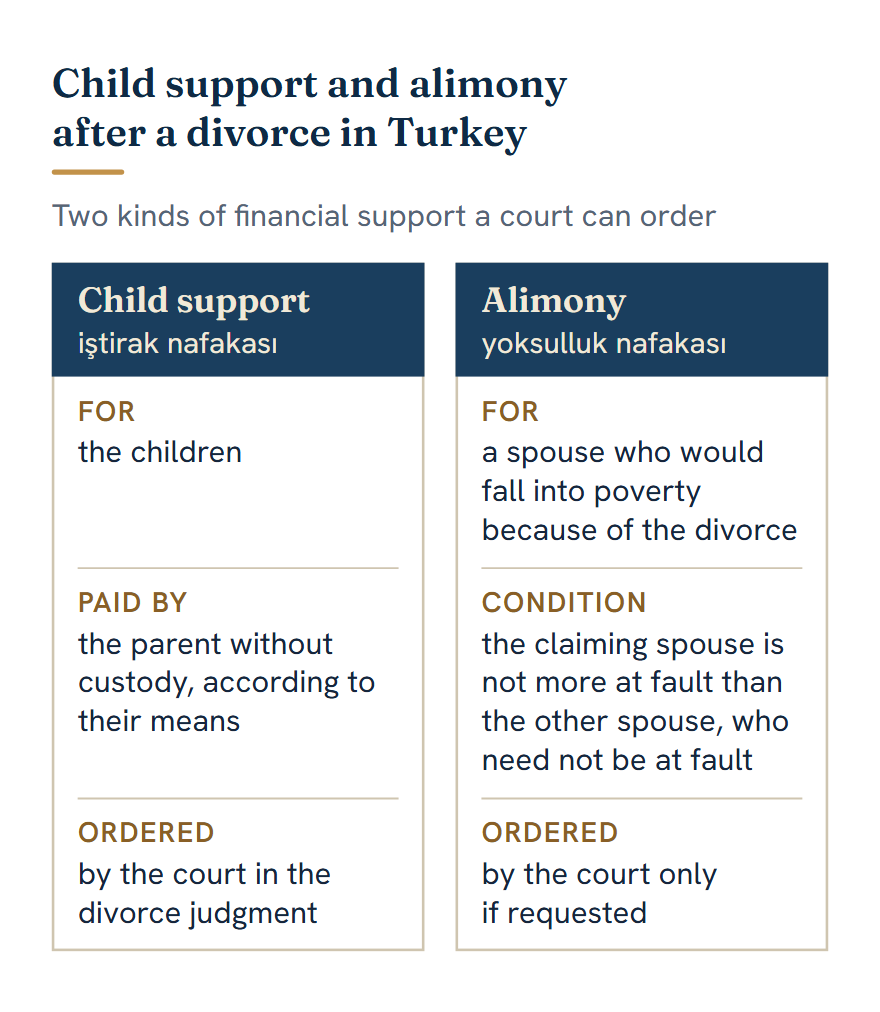
After a divorce, the court can order two kinds of financial support: child support (iştirak nafakası) for the children and alimony (yoksulluk nafakası) for a spouse who would fall into poverty because of the divorce. The frequently asked questions explain how the amounts are determined; support during the case is covered in the section on temporary support and protection orders.
What Is Child Support?
Child support is the contribution that the parent without custody must make, according to their means, to the costs of the child’s care, including health care, and education (Turkish Civil Code, TMK Article 182). The court sets it in the divorce judgment, and it lasts until the child reaches adulthood (TMK Article 328(1)).
Does Child Support Continue After the Child Turns 18?
Child support ends automatically when the child reaches adulthood, normally at 18, but if the child’s education continues, the parents may still have to support the child (TMK Articles 11 and 328). This duty lasts until the education ends, as far as can be expected of the parents in the circumstances, and the adult child must claim this support in their own name, since a parent can no longer do so for them (Court of Cassation, 2nd Civil Chamber, decision of 13 September 2017, E.2016/3712, K.2017/9401).
Who Can Claim Alimony After a Divorce?
You can claim alimony if the divorce would leave you in poverty and you are not more at fault than your spouse; your spouse does not need to be at fault (TMK Article 175). The court awards it only if you request it (HMK Article 26).
Can Alimony Be Limited in Time?
Yes. You and your spouse can agree on a time limit in an uncontested divorce, subject to the judge’s approval, and a request for alimony for a limited period limits the award, because the court cannot award more than is requested (TMK Articles 166(3) and 184(5); HMK Article 26). Otherwise, Article 175 allows you to request alimony for an indefinite period, with no fixed end date.
The Turkish Constitutional Court (Anayasa Mahkemesi) has annulled the words “for an indefinite period” (süresiz olarak) in Article 175, with effect from 30 June 2027 (decision of 4 June 2026, E.2025/156, K.2026/131; Official Gazette 30 September 2026, No. 33386). The decision itself does not set a time limit.
When Does Alimony End or Change?
Alimony paid periodically, rather than as a lump sum, ends automatically if the receiving spouse remarries or either former spouse dies. A court order is needed to end it if the receiving spouse lives with someone as if married, is no longer in poverty or leads a dishonorable life.
The court can increase or reduce periodic alimony when the former spouses’ financial circumstances change or fairness requires. On request, it can also set the amounts payable in future years according to the parties’ social and economic circumstances (TMK Article 176).
How Is Property Divided in a Divorce?
Under the statutory property regime, you do not automatically become the owner of half of each asset. Each spouse has a financial claim to half of the residual value (artık değer) of the other spouse’s acquired property (edinilmiş mal): its value, including amounts added back and adjustments, minus the related debts. The two claims are set off against each other (Turkish Civil Code, TMK Articles 231 and 236). Personal property (kişisel mal) stays with its owner, and a deficit in this calculation is not shared.
What Is Turkey’s Default Matrimonial Property Regime?
Unless you and your spouse chose another regime by contract, the statutory regime is participation in acquired property (edinilmiş mallara katılma), in force since 1 January 2002 (TMK Articles 202 and 1029). For marriages concluded before that date, the earlier regime generally governs the period up to then, subject to the transitional rules in Law No. 4722, Article 10.
Acquired property means assets a spouse obtains for value during the regime, in particular (TMK Article 219):
- earnings from work;
- payments from social security or welfare institutions and staff benefit funds;
- compensation for loss of working capacity;
- income from personal property;
- assets that replace acquired property.
Personal property under TMK Article 220 includes:
- items used only by one spouse personally;
- assets a spouse owned when the regime began, or later received by inheritance or another gratuitous acquisition, such as a gift;
- claims for moral damages;
- assets that replace personal property.
Can You Claim for Your Contribution to Your Spouse’s Property?
Yes, if you contributed to acquiring, improving or preserving an asset that belongs to your spouse without receiving adequate value in return, even if it is your spouse’s personal property. Your claim is calculated by applying your contribution rate to the asset’s value at the liquidation of the property regime, so it covers your contribution together with its share of any increase in value; if the asset has lost value, the original value of your contribution is taken as the basis (TMK Article 227(1)). By written agreement, spouses can waive their share in the increase in value or change the proportion (TMK Article 227(3)).
For example, if your spouse bought an apartment before the marriage and you contributed to its renovation during the marriage, you may have a claim reflecting your contribution and any corresponding increase in value.
When Can You File a Matrimonial Property Claim?
You can bring the claim together with the divorce case or separately. If the court grants the divorce, the property regime ends with effect from the date the case was filed, and the acquired property existing at that date is counted at its value at liquidation (TMK Articles 225(2) and 235). The claim is subject to the general ten-year limitation period, which runs from the date the divorce judgment becomes final (Turkish Code of Obligations, TBK Article 146; Court of Cassation, Assembly of Civil Chambers, decision of 15 March 2022, E.2019/238, K.2022/319). The one-year period in TMK Article 178 does not apply to this claim.
Does Adultery Affect the Division of Property?
Only if the divorce is granted on the ground of adultery or an attempt on life can the judge reduce or remove the at-fault spouse’s share of the residual value, as fairness requires (TMK Article 236(2)). The rule concerns only that participation share and does not change who owns personal property.
Who Bears the Burden of Proof in a Matrimonial Property Case?
A spouse who says an asset is personal property must prove it, because all of a spouse’s assets are presumed to be acquired property until the contrary is proven. Anyone who claims that an asset belongs to one of the spouses must also prove it, and an asset whose owner cannot be shown is treated as owned by both spouses in shares (TMK Article 222).
How Are Expert Reports Used in Property Division?
Courts often appoint experts to value the assets, trace the funds used to acquire them and calculate the participation and contribution claims; the legal assessment stays with the judge (HMK Article 266). Depending on the assets, the experts may include real estate appraisers or financial experts.
How Is Property Divided in an Uncontested Divorce?
You and your spouse can agree on how to divide your property and include it in the divorce settlement agreement, which the judge reviews with the rest of the agreement. The agreement should clearly list the assets and their values, how responsibility for debt payments is allocated between you and any steps needed to complete a transfer of title.
What Can You Do If Your Spouse Hides or Transfers Assets?
You can ask the court for an injunction (ihtiyati tedbir) concerning the disputed assets, such as a restriction recorded in the land registry, where delay or a change in circumstances could seriously harm your rights. You must state the measure and its grounds and make a preliminary showing that your claim is justified (HMK Articles 389 and 390). Land registry, bank and tax records can be examined to find assets.
During the divorce case, the judge can also take measures on the management of the spouses’ property (TMK Article 169). Where needed to protect the family’s economic position or to meet a financial obligation arising from the marriage, you can ask the court to make transactions involving specific assets subject to your consent, recorded in the land registry for real estate (TMK Article 199).
Certain transfers are added back to the value of acquired property: gratuitous transfers made without your consent in the year before the regime ended, other than ordinary gifts, and transfers made during the regime with the intent of reducing your participation claim (TMK Article 229). Assets added back are counted at their value on the date of transfer (TMK Article 235).
If your spouse’s assets cannot cover your participation claim at liquidation, you can claim the gratuitous transfers that must be added back from the people who received them, up to the amount still owed; this right expires one year after you learn that your rights were harmed and in any case five years after the regime ended (TMK Article 241). A sham transaction can also be challenged in a separate case on its own legal basis (Turkish Code of Obligations, TBK Article 19). The court hearing that case first waits for the outcome of your property claim. If the sham is proven, it does not cancel the transfer in the land registry but allows the asset to be seized and sold to pay what you are owed (Court of Cassation, Assembly of Civil Chambers, decision of 10 December 2019, E.2018/378, K.2019/1329).
Property division is one of the most complex stages of a divorce, and professional legal support helps protect your rights.
What Temporary Support and Protection Orders Are Available During a Divorce?
Once the divorce case is filed, the judge takes, on their own initiative, the interim measures (geçici önlemler) needed while the case continues, especially for housing, support, the management of the spouses’ property and the care and protection of the children (Turkish Civil Code, TMK Article 169). Protection under Law No. 6284 on the Protection of the Family and the Prevention of Violence Against Women is also available if you or your children experience violence or are at risk of it, whether or not a divorce case has been filed.
What Is Temporary Support During a Divorce?
Temporary support (tedbir nafakası) is financial support ordered to meet a spouse’s or the children’s needs while the divorce case continues (TMK Article 169). You can ask for this support, and the judge can also order it without a request.
What Happens If Temporary Support Is Not Paid?
Unpaid support can be collected through enforcement proceedings (icra takibi). In qualifying cases, the enforcement court may also order coercive detention (tazyik hapsi) of up to three months on the complaint of the person entitled to the support, and the debtor is released once they comply (Enforcement and Bankruptcy Law, İİK Articles 344 and 346; Court of Cassation, 12th Civil Chamber, decision of 20 January 2026, E.2026/227, K.2026/222).
How Do Protection Orders Under Law No. 6284 Work?
If you or your children face violence or the threat of violence, you can ask for protective measures (koruyucu tedbirler), which support your safety, and preventive measures (önleyici tedbirler), which restrict the person using or threatening violence. A protective measure does not require evidence or documents showing that violence occurred, and a preventive measure must be ordered without delay (Law No. 6284, Articles 3 to 5 and 8(3)).
You can apply to a family court judge, the provincial or district governor (vali or kaymakam) or a law enforcement unit, whichever is quickest and easiest to reach, in writing, orally or in any other way. No court fees or other official charges are payable (Law No. 6284, Articles 2, 8(1) and 20(1); Implementing Regulation, Article 4).
In urgent cases, the relevant law enforcement chief can order certain preventive measures, including removal from the shared home, and must submit the documents to the judge by the next working day; measures the judge does not approve within 24 hours lapse (Law No. 6284, Article 5(2); Implementing Regulation, Article 29).
The first order can last up to six months and can be extended or changed if the violence or the risk of violence continues (Law No. 6284, Article 8(2)).
Preventive measures can include (Law No. 6284, Article 5(1)):
- removing the person using or threatening violence from the shared home;
- a ban on approaching you, your home, school or workplace;
- a ban on harassing you by phone or other means;
- surrendering legally held weapons to law enforcement;
- a ban on damaging your personal and household belongings.
What Happens If a Protection Order Is Violated?
A judge can order coercive detention (zorlama hapsi) of three to ten days, depending on the nature of the measure breached and the seriousness of the breach, and fifteen to thirty days for each repeated violation, up to six months in total, even if the violation is also a crime (Law No. 6284, Article 13).
How Much Does a Divorce Lawyer in Adana Cost?
The minimum attorney’s fee for a divorce case in Adana is TRY 62,000, excluding VAT. This comes from the 2027 Minimum Attorney Fee Tariff (Avukatlık Asgari Ücret Tarifesi, AAÜT), in force since 3 November 2026, and is a national minimum, not a fixed price: the fee you agree with your lawyer depends on your case and may be higher.
The amount is the tariff’s rate for cases before the general civil courts (asliye mahkemeleri), and family courts are courts of that level (AAÜT 2027, Official Gazette No. 33419, Part Two, Section Two, item 10; Law No. 4787, Article 2). The tariff is updated each year, and a fee cannot be agreed below it (Attorneys’ Act No. 1136, Articles 164 and 168).
What Affects a Divorce Lawyer’s Fee?
The main factors are whether your divorce is contested or uncontested, the complexity and value of any property issues, any custody or support issues, and the lawyer’s experience and expertise. Unless your agreement says otherwise, the fee covers only the work your lawyer takes on, and another case, even a connected one such as a counterclaim or a matrimonial property claim, requires a separate fee (Attorneys’ Act No. 1136, Article 173).
Are Court Fees Included in the Attorney’s Fee?
No. Court fees (harç), the advance on court expenses (gider avansı) and other expenses are separate from your lawyer’s fee and, unless agreed otherwise, are your responsibility (Attorneys’ Act No. 1136, Article 173). When they are paid is explained in the section on filing for divorce (HMK Article 120(1)).
How Can You Challenge a Divorce Judgment?
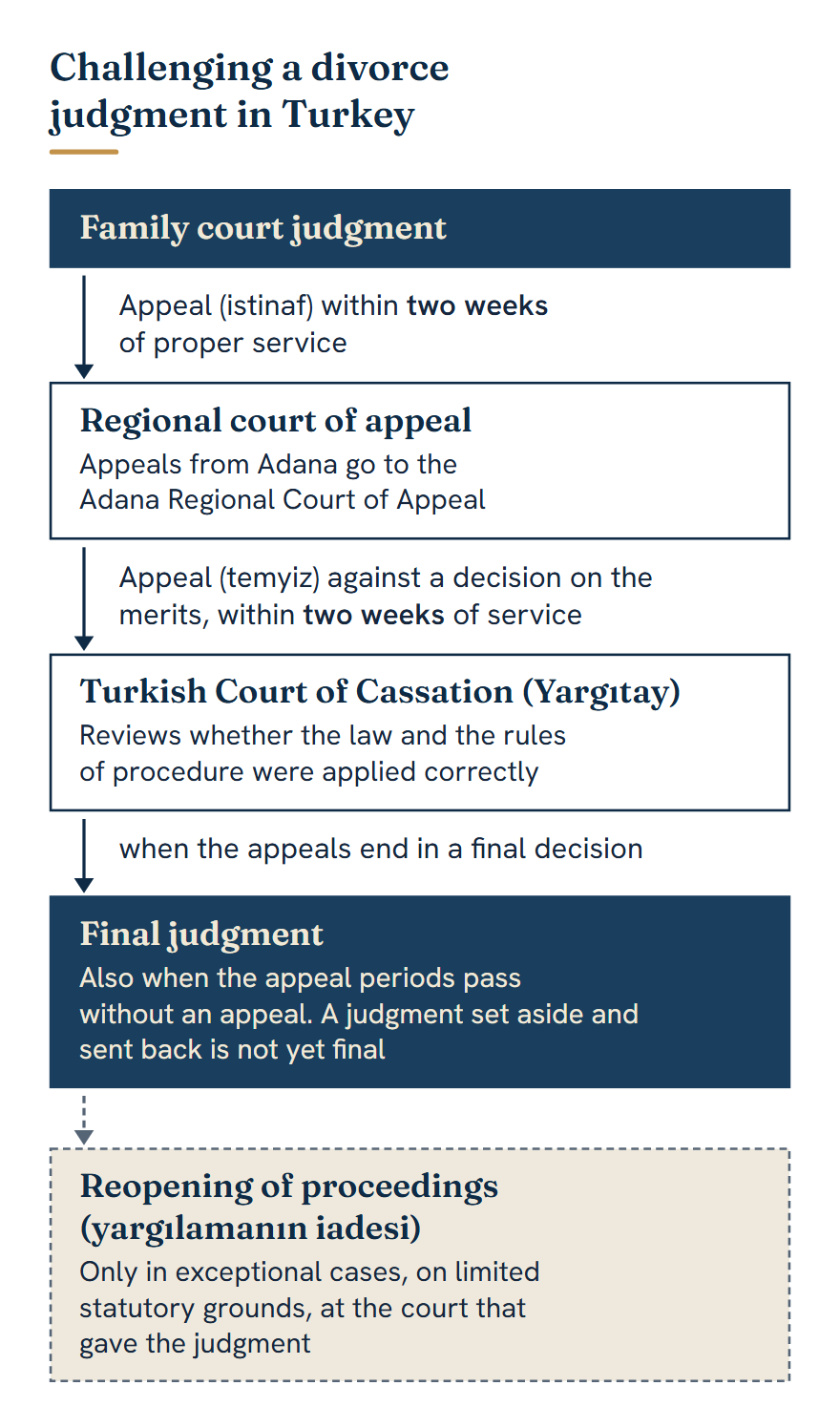
You can appeal the family court’s judgment to the regional court of appeal (istinaf) within two weeks of proper service, and the regional court’s decision on the merits to the Court of Cassation (temyiz) within two weeks of service (Code of Civil Procedure, HMK Articles 345(1) and 361(1)). A final judgment can be reopened only in exceptional cases (HMK Article 374).
How Does an Appeal to the Regional Court of Appeal Work?
The regional court of appeal reviews the family court’s judgment on the facts and the law, but only on the grounds raised in the appeal petition, apart from matters of public order, which it examines on its own (HMK Article 355). You file the petition within two weeks of proper service, either with the court that gave the judgment or with another first-instance court (HMK Articles 343(1) and 345(1)). Appeals from Adana go to the Adana Regional Court of Appeal, which also covers Mersin, Hatay and Osmaniye.
What Should Your Appeal Petition Include?
It must identify the parties, the judgment and the date it was served on you, set out your grounds and the outcome you ask for, and be signed (HMK Article 342(2)). The grounds should be concrete, not simply that you disagree: for example, that the court decided custody without considering the child’s best interests or, in a property case, that it did not take into account assets you owned before the marriage.
How Does an Appeal to the Court of Cassation Work?
The regional court’s decision on the merits can be appealed to the Court of Cassation within two weeks of service, though a decision sending the case back cannot be appealed further (HMK Articles 361(1) and 362). Divorce appeals are heard by its 2nd Civil Chamber.
The Court of Cassation reviews whether the law and the rules of procedure were applied correctly, such as the custody rules of the Civil Code, and your petition should set out these legal errors clearly (HMK Articles 364(2) and 371(1)). It is not limited to the grounds you raise and can also examine other clear breaches of the law (HMK Article 369(1)).
When Does a Divorce Judgment Become Final?
A divorce judgment becomes final when the appeal periods pass without an appeal against it or the appeals end in a final decision; a judgment set aside and sent back is not yet final (HMK Articles 353 and 373). Until then the divorce cannot be enforced or recorded in the civil registry, but an appeal against only other parts of the judgment, such as alimony or compensation, does not necessarily prevent the divorce itself from becoming final (HMK Articles 297(2), 350(2) and 367(2)).
Temporary support continues while the case is pending, whereas alimony and child support awarded in the divorce judgment depend on the divorce becoming final; an enforceable support award cannot be stayed pending appeal (HMK Articles 350(1) and 367(1); Enforcement and Bankruptcy Law, İİK Article 36). For other money awards, such as a property claim, enforcement before finality depends on the award, and a stay generally requires security (İİK Article 36).
Can Divorce Proceedings Be Reopened After a Final Judgment?
Only in exceptional cases. Reopening of proceedings (yargılamanın iadesi) is available on limited statutory grounds, for example a judgment based on a document found or admitted to be forged or on false witness testimony, or a document obtained after the judgment that the losing party could not obtain during the case for reasons beyond their control (HMK Articles 374 and 375).
Grounds based on false testimony, a deliberately false expert or interpreter statement or a false oath generally require a final criminal conviction (HMK Article 375(2)). The usual time limit is three months from the event the law specifies for the ground, and a general ten-year limit runs from the date the judgment became final, with special rules for certain grounds (HMK Article 377). The application goes to the court that gave the judgment (HMK Article 378(1)).
What Should You Look for When Choosing a Divorce Lawyer in Adana?
When choosing a divorce lawyer in Adana, look for four things: experience in divorce cases, specialization in family law, open communication and transparency about fees and strategy. Everyone wants to work with the best lawyer, and these are the main points to weigh:
- Experience: an experienced divorce lawyer can manage the process more effectively, and asking how many active cases the lawyer has before the Adana Family Courts, and whether they have handled cases like yours, can guide you.
- Specialization: look for a lawyer who specializes in divorce cases, since such lawyers know the law and court procedures better, and keeping up with recent Court of Cassation decisions and local court practice requires that specialization.
- Communication: open and honest communication with your lawyer helps the case progress well, and in a long case you will want to stay in regular contact, so ask how you will be kept informed and how you can reach your lawyer.
- Transparency: your lawyer should be transparent about fees, the work the fee covers and case strategy, and we recommend a written fee agreement.
The advantages of working with an expert divorce lawyer registered with the Adana Bar Association: protecting your legal rights, choosing the right strategy, a faster process, a lighter emotional burden, command of local court practice in Adana, and up-to-date knowledge of legislation and case law.
What Do People Frequently Ask a Divorce Lawyer in Adana?
How is child custody decided in a divorce?
The family court decides custody (velayet) in the child’s best interests. As a rule, it hears a child capable of forming their own views and gives those views due weight (Turkish Court of Cassation, 2nd Civil Chamber, decision of 16 April 2026, E.2026/1871, K.2026/4287). It also hears both parents where possible (Turkish Civil Code, TMK Article 182(1)) and weighs each parent’s circumstances, their relationship with the child and their living conditions.
How is contact with the children arranged after a divorce?
In the divorce judgment, the family court in Adana sets the personal relations (kişisel ilişki) between the child and the parent without custody, based on the child’s interests (Turkish Civil Code, TMK Article 182). The arrangement usually includes regular visits on fixed days and times and contact during school vacations and holidays, depending on the child’s age, schooling, the distance between the parents and their work schedules.
How is the amount of alimony determined?
In Turkey, there is no fixed formula: the judge sets alimony at their discretion and in fairness, for the subsistence of the spouse who would fall into poverty because of the divorce and in proportion to the paying spouse’s financial means (Turkish Civil Code, TMK Articles 4 and 175). The court weighs both spouses’ income, needs and social and economic circumstances, and can order alimony as a lump sum or as periodic payments (TMK Article 176(1)).
How is the amount of child support determined?
In Turkey, the court sets child support based on the child’s needs, including education costs, and on both parents’ living conditions and ability to pay; it also takes into account any income the child has (Turkish Civil Code, TMK Article 330). It is paid monthly in advance, and on request the court can also decide how much will be paid in future years. If circumstances change, either parent can ask the court to set a new amount or end it (TMK Article 331).
How Can You Arrange an Initial Consultation?
You can request an Initial Consultation through the form on this page to discuss how we can help with your case.
Divorce is a complex legal process, and the decisions you make along the way can affect your future. An experienced divorce lawyer can help you protect your rights and work toward a fair resolution. At İncekaş Law Office in Adana, we assess each case on its own facts and develop a strategy tailored to your situation.
Request an Initial Consultation
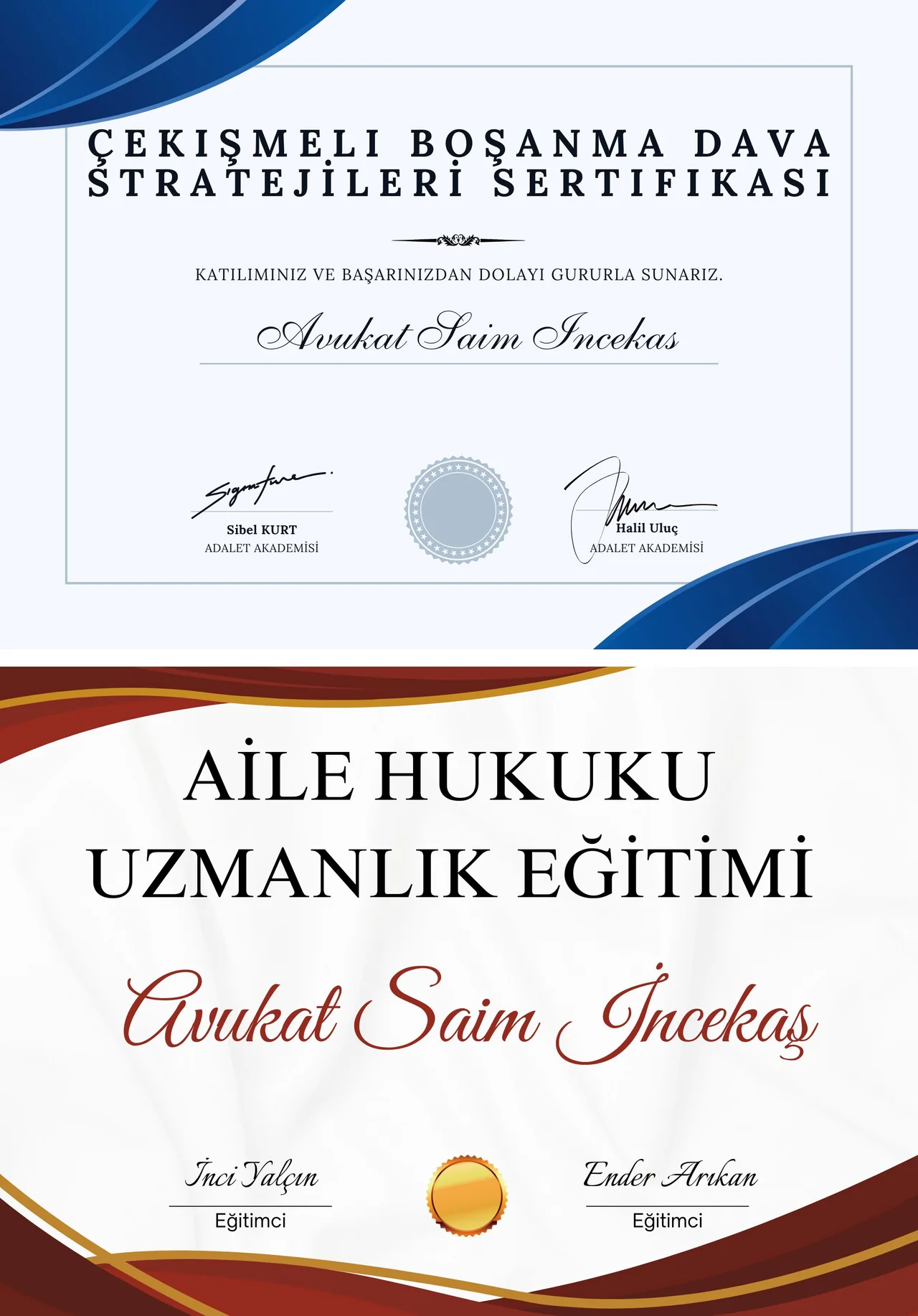
Attorney Saim İncekaş’s Divorce and Family Law Training Certificates